
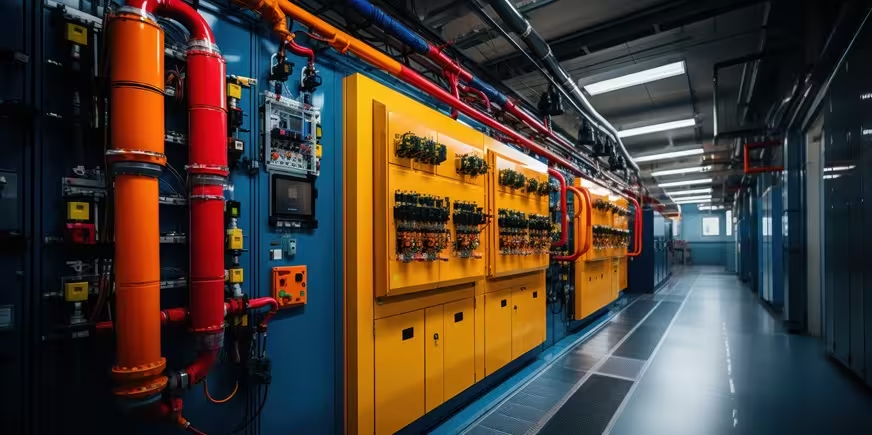
Diesel Generator Systems
Perfect Solution Contracting provides integrated diesel generator solutions for standby, emergency, and other approved power applications in commercial buildings, industrial facilities, infrastructure projects, utilities, data centers, and critical facilities.
Generator systems provide an alternative source of electrical power when the normal utility supply is unavailable or when an independent generation source is required by the approved electrical design.
Our scope can include engineering coordination, technical and material submittals, generator supply, transportation and positioning, installation, electrical connections, fuel-system interfaces, exhaust arrangements, ventilation and cooling coordination, control interfaces, earthing, testing, commissioning, and final handover according to project requirements.
Generator Sizing & Rating
Generator selection is based on the required electrical load, load characteristics, operating duty, system voltage, frequency, power factor, motor starting requirements, nonlinear loads, environmental conditions, required redundancy, and approved project design.
Generator sets are commonly rated in kVA and kW. Both ratings should be considered together with the generator's rated power factor and the characteristics of the connected loads.
Generator sizing should not be based solely on the arithmetic total of connected loads. The actual demand, load sequence, starting currents, step loading, transient voltage and frequency response, diversity, future requirements where specified, and operating philosophy should be considered.
Large motors, pumps, fans, compressors, elevators, chillers, and other equipment can impose significant starting or transient loads. Their starting method and operating sequence should therefore be considered during generator sizing.
Loads incorporating UPS, variable-frequency drives (VFDs), rectifiers, and other power-electronic equipment can also affect generator selection and should be coordinated with the generator and alternator characteristics.
Standby & Prime Power Ratings
Generator rating is selected according to the intended operating duty. Applications can require standby, prime, or another manufacturer-defined rating depending on the expected operating profile and project requirements.
A standby-rated generator should not automatically be treated as suitable for continuous or prime-duty operation. The applicable rating, permissible loading, and operating hours should correspond to the selected generator manufacturer's published rating conditions.
Diesel Engine
The diesel engine is selected to provide the mechanical power required by the alternator under the specified operating and environmental conditions.
Engine systems can include starting equipment, lubrication, cooling, air intake, fuel supply, electronic or mechanical governing, sensors, and protective devices according to the selected generator design.
Engine performance should be coordinated with ambient temperature, altitude, ventilation, cooling arrangement, fuel characteristics, and other site conditions that can affect available generator output.
Alternator
The alternator converts the mechanical power from the diesel engine into electrical power at the required voltage and frequency.
Alternator selection considers rated output, voltage, frequency, insulation system, temperature rise, excitation system, short-circuit performance, voltage regulation, load characteristics, and environmental conditions.
An Automatic Voltage Regulator (AVR) is typically used to regulate generator output voltage within the operating characteristics of the selected generating set.
Generator Control Panel
The generator control panel provides monitoring, starting, stopping, alarms, shutdown functions, and operating status for the generating set according to the selected controller and project requirements.
Monitored parameters can include generator voltage, current, frequency, power, engine speed, battery voltage, coolant temperature, oil pressure, operating hours, fuel-related signals, and other available parameters.
Protective shutdowns and alarms depend on the generator design and can include conditions such as low oil pressure, high coolant temperature, overspeed, starting failure, electrical faults, and other manufacturer-defined protections.
Automatic Transfer System
Where automatic standby operation is required, the generator can be coordinated with an Automatic Transfer Switch (ATS) or approved automatic transfer arrangement.
The transfer system monitors the normal electrical supply and, according to the approved sequence of operation, can initiate generator starting and transfer the designated loads to the generator source after the required conditions are satisfied.
When the normal source is restored and stable, the system can transfer the load back according to the approved timing and control sequence and allow the generator to complete its required cool-down cycle before stopping.
Transfer timing, source-failure criteria, return delays, cool-down periods, and other parameters are coordinated with the electrical system design and approved operating philosophy.
Synchronization & Paralleling
Projects requiring multiple generator sets can use synchronization and paralleling systems where specified by the approved electrical design.
Paralleling systems can coordinate generator starting, synchronization, load sharing, generator sequencing, bus control, protection, and other operating functions according to the required power architecture.
Generator paralleling should be specifically engineered for the selected equipment and network arrangement and should not be assumed as part of a standard single-generator installation.
Generator Batteries & Battery Chargers
Generator starting systems typically incorporate starting batteries selected according to the engine manufacturer's requirements and the required starting performance.
Battery chargers can be provided to maintain the starting batteries in the required state of charge while normal auxiliary power is available.
Battery installation includes coordination of battery type, voltage, capacity, cabling, terminals, charger, mounting arrangement, ventilation where applicable, and maintenance accessibility.
Fuel System
The generator fuel system is designed according to the generator capacity, required operating duration, engine fuel consumption, project requirements, and approved fuel-storage philosophy.
Depending on the project, the fuel arrangement can include a generator base tank, day tank, bulk storage tank, transfer pumps, fuel piping, valves, level monitoring, filtration, and associated controls.
The exact fuel-system configuration depends on the required runtime, generator arrangement, site conditions, applicable requirements, and approved project design.
Fuel storage and transfer systems require coordination with architectural, mechanical, fire-safety, environmental, structural, and electrical requirements relevant to the project.
Exhaust & Silencer System
Diesel generator exhaust systems are designed to route engine exhaust gases to the approved discharge location while maintaining acceptable exhaust backpressure within the engine manufacturer's limits.
The exhaust arrangement can include exhaust piping, flexible connections, silencers, supports, insulation, weather protection, and other accessories required by the approved installation.
Silencer selection depends on the required acoustic performance, installation arrangement, exhaust flow, allowable backpressure, and project requirements.
Exhaust routing should be coordinated with building openings, air intakes, occupied areas, façades, structural supports, and other services.
Cooling & Ventilation
Generator cooling can be provided through an engine-mounted radiator, remote radiator, or another approved cooling arrangement depending on the selected generator and installation conditions.
A remote radiator is therefore not required for every generator installation. The cooling configuration is selected according to the generator design, room arrangement, heat rejection, airflow, ambient conditions, and project requirements.
Generator rooms require adequate ventilation to provide combustion air and remove heat generated by the engine, alternator, exhaust system, radiator, and other equipment.
Ventilation coordination considers air inlet and outlet locations, required airflow, pressure drop, louvers, ductwork where applicable, room temperature, radiator airflow, and manufacturer requirements.
Acoustic Treatment & Enclosures
Where acoustic performance is specified, generator installations can include acoustic enclosures, attenuators, silencers, acoustic doors, wall or ceiling treatments, and other measures depending on the required noise criteria.
Outdoor generator sets can be supplied with weatherproof or acoustic enclosures where required by the project and suitable for the selected installation environment.
Acoustic treatment should be coordinated with ventilation and cooling requirements so that noise reduction measures do not create unacceptable airflow restrictions or operating temperatures.
Concrete Base & Vibration Isolation
Generator installation is coordinated with the structural design for the required equipment support, floor loading, concrete foundation or inertia base where applicable, fixing points, and maintenance access.
Vibration isolation can be provided using the generator manufacturer's mounting system or additional approved isolation arrangements depending on the equipment design and project requirements.
Electrical Connections
Generator output connections are coordinated with the generator circuit breaker, switchgear, ATS, synchronization panel where applicable, and downstream electrical distribution system.
Connections can use power cables, busduct, or another approved distribution arrangement depending on the generator current rating, installation configuration, and project design.
Cable sizing considers generator rated current, installation method, ambient conditions, grouping, voltage drop, short-circuit withstand, conductor arrangement, and applicable correction factors.
Generator Protection
Generator electrical protection is selected according to generator capacity, alternator characteristics, grounding arrangement, network configuration, and the approved protection philosophy.
Protection can include overcurrent, earth fault, reverse power, under-voltage, over-voltage, under-frequency, over-frequency, differential, and other functions where applicable to the selected generating system.
The exact protection functions depend on the generator application, size, paralleling arrangement, system grounding, and approved protection study.
Earthing & Neutral Arrangement
Generator earthing and bonding are coordinated with the facility's overall earthing system and the electrical distribution design.
The generator neutral and grounding arrangement depends on the system configuration, transfer-switch arrangement, grounding philosophy, and protection requirements.
Neutral-to-earth bonding should therefore be implemented only at the locations defined by the approved electrical design rather than assumed to be identical for every generator installation.
BMS, EPMS & Remote Monitoring
Where specified, generator systems can interface with a Building Management System (BMS), Electrical Power Monitoring System (EPMS), or SCADA platform.
Integration points can include generator running status, available status, common alarm, failure, electrical measurements, fuel-level information, breaker status, ATS status, and other data supported by the selected equipment and approved points list.
Technical Submittals & Coordination
Before procurement, technical documentation can include generator data sheets, engine and alternator information, ratings, fuel consumption, dimensions, weights, noise data, exhaust data, heat rejection, ventilation requirements, control details, battery information, and accessories.
Coordination documentation can include Single Line Diagrams (SLD), General Arrangement (GA) drawings, generator room layouts, fuel-system schematics, exhaust layouts, ventilation details, control diagrams, and cable schedules.
Factory Acceptance Testing
Where required by the project, Factory Acceptance Testing (FAT) can be performed before shipment according to the approved inspection and testing requirements.
FAT can include verification of generator configuration, control functions, alarms, shutdowns, electrical output, operating parameters, and load testing as specified in the approved Inspection & Test Plan (ITP).
Site Installation & Pre-Commissioning
Following delivery, the generator is inspected for transportation condition, completeness, accessories, nameplate information, physical damage, and installation requirements.
Site installation verification can include generator positioning, supports, vibration isolation, fuel connections, exhaust system, ventilation interfaces, electrical connections, batteries, charger, earthing, control wiring, and monitoring interfaces.
Pre-commissioning checks include fluid levels, battery condition, charger operation, engine systems, electrical connections, insulation where applicable, control circuits, alarms, emergency stop functions, protection settings, and other manufacturer-required checks.
Load-Bank Testing
Where specified, a load bank can be used to test the generator under controlled electrical loading and verify operating performance at defined load steps.
Load-bank testing can be used to observe generator voltage, frequency, engine parameters, cooling performance, control response, and other specified operating conditions.
The test duration, loading sequence, load percentages, acceptance criteria, and recorded parameters should be defined by the approved commissioning procedure, project requirements, and generator manufacturer.
Functional Testing & Commissioning
Functional testing verifies generator start and stop sequences, alarms, shutdowns, breaker operation, control functions, battery charger, emergency stop, monitoring interfaces, and other specified functions.
Where an ATS is installed, testing includes simulation of normal-source failure, generator starting, source transfer, operation on generator supply, restoration of normal power, retransfer, and generator cool-down according to the approved sequence.
Where generators operate in parallel, commissioning can include synchronization, load sharing, generator sequencing, protection, bus control, and failure-mode testing according to the approved system design.
Where required, Site Acceptance Testing (SAT) can verify the complete installed generator system and its interfaces with the ATS, switchgear, fuel system, controls, monitoring systems, and connected electrical distribution network.
Perfect Solution Contracting provides complete diesel generator solutions covering engineering coordination, technical submittals, procurement, transportation, positioning, installation, electrical and control connections, fuel and exhaust coordination, cooling and ventilation interfaces, earthing, FAT/SAT support where required, load-bank testing, commissioning, and final handover.
- Diesel generator sets.
- Standby and emergency power applications.
- Standby and prime rating coordination.
- Generator kVA / kW sizing.
- Diesel engines and alternators.
- Automatic Voltage Regulators (AVR).
- Generator control panels.
- Automatic Transfer Switch (ATS) integration.
- Automatic mains-failure operating sequence.
- Synchronization and paralleling where specified.
- Starting batteries and battery chargers.
- Base tanks, day tanks, and bulk fuel-system interfaces where required.
- Fuel transfer pumps and controls where specified.
- Exhaust piping and silencers.
- Engine-mounted or remote radiator coordination.
- Generator room ventilation.
- Acoustic treatment and enclosures where required.
- Concrete bases and equipment supports.
- Vibration isolation.
- Generator output cables or busduct interfaces.
- Generator protection coordination.
- Earthing and bonding.
- Neutral and grounding coordination.
- BMS / EPMS / SCADA integration where specified.
- Single Line Diagrams (SLD).
- General Arrangement (GA) drawings.
- Factory Acceptance Testing (FAT) where required.
- Site Acceptance Testing (SAT) where required.
- Load-bank testing where specified.
- ATS functional testing.
- Testing, commissioning, and final handover.