
Intelligent Lighting Control Systems
Perfect Solution Contracting provides intelligent lighting control solutions for commercial, residential, hospitality, industrial, infrastructure, and other building applications. Lighting control systems can provide centralized or distributed control of lighting circuits according to occupancy, daylight, time schedules, scenes, user commands, and operational requirements.
Our scope can include engineering coordination, technical and material submittals, supply, installation, programming, testing, commissioning, system integration, documentation, and support during the applicable warranty period according to approved project requirements.
Intelligent Lighting Control
Intelligent lighting control systems can automate lighting operation while allowing individual luminaires, groups, zones, or complete areas to be controlled according to the selected system architecture and operational requirements.
Control strategies can include manual switching, automatic switching, dimming, occupancy-based control, daylight-responsive control, time scheduling, scene selection, and centralized commands.
Lighting Control Panels
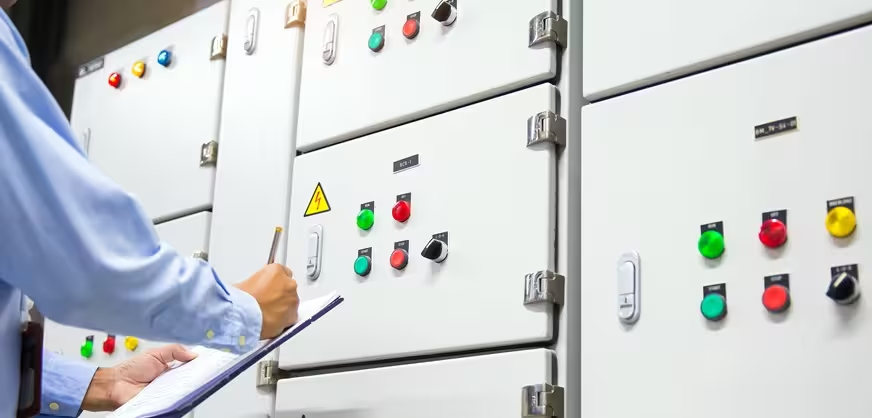
Lighting control panels can contain relays, controllers, communication interfaces, power supplies, input/output modules, protection devices, and other components required by the approved lighting control architecture.
Panel configuration is coordinated with the number and type of controlled circuits, connected loads, control method, communication protocol, zoning requirements, electrical distribution system, and project specifications.
Dimming Control
Dimming systems allow lighting output to be adjusted according to the requirements of each space. Dimming can support operational flexibility, architectural scenes, visual comfort, and energy-management strategies where compatible luminaires and LED drivers are installed.
The selected dimming technology must be coordinated with the luminaires, LED drivers, controllers, and lighting control equipment. Compatibility should be verified before installation and commissioning.
DALI Lighting Control
Digital Addressable Lighting Interface (DALI) can be used where digitally addressable lighting control is required for individual luminaires or groups of luminaires.
A DALI-based solution can provide functions such as switching, dimming, grouping, scene control, status monitoring, and other functions supported by the selected DALI devices and control system.
DALI system design requires coordination of control devices, bus topology, addressing, bus power supplies, gateways, luminaires, LED drivers, interfaces, and commissioning requirements.
Occupancy & Motion Sensors
Occupancy and motion sensors can automatically control lighting according to the presence or absence of people within designated areas.
Sensor locations, detection coverage, mounting height, sensitivity, time delay, and operating mode are coordinated with the intended use and physical characteristics of each space.
Daylight Sensors
Daylight sensors can be used to adjust artificial lighting according to the available natural light where daylight-responsive control is included in the approved lighting strategy.
The system can switch or dim selected lighting zones according to sensor readings and programmed control parameters, subject to the capabilities of the installed luminaires and control equipment.
Photocell Control
Photocells can provide automatic control of external lighting or other designated lighting circuits according to ambient light conditions.
Photocell operation can be coordinated with time schedules, astronomical clocks, manual overrides, or centralized lighting controls according to project requirements.
Time Scheduling
Lighting operation can be programmed according to specific operating hours, days, zones, or facility activities.
Scheduled control can be applied to common areas, external lighting, parking areas, circulation spaces, landscape lighting, and other areas with defined operating periods.
Scene Control
Scene control allows predefined lighting levels or combinations of lighting circuits to be recalled for different activities and operating conditions.
Scene control can be applied in meeting rooms, auditoriums, reception areas, hospitality spaces, multipurpose rooms, architectural areas, and other applications requiring different lighting conditions.
Local Control Devices
Local control can include wall switches, push buttons, scene-control plates, touch panels, dimmer controls, key switches, and other user interfaces supported by the selected system.
Local controls are coordinated with the required operating philosophy, architectural finishes, accessibility, lighting zones, and centralized control functions.
Manual Override
Manual override functions can be provided where operators require direct control of designated lighting circuits or zones independently of normal automatic commands.
Override operation and priority should be defined within the approved control philosophy to avoid conflicts between local controls, schedules, sensors, and centralized commands.
Indoor Lighting Control
Indoor lighting control can be applied to offices, corridors, meeting rooms, reception areas, public spaces, residential areas, hospitality spaces, service areas, and other internal zones.
The appropriate control strategy depends on occupancy, daylight availability, required lighting levels, operational schedules, user requirements, and the capabilities of the installed lighting equipment.
External Lighting Control
External lighting control can include roads, parking areas, pedestrian walkways, building surroundings, landscape areas, architectural façades, and other exterior lighting applications.
Depending on project requirements, external lighting can be controlled using photocells, astronomical time schedules, contactors, lighting control panels, programmable controllers, or centralized control systems.
Road & Parking Area Lighting
Road and parking lighting circuits can be divided into suitable control zones and operated according to schedules, photocells, operational requirements, or centralized commands.
Control arrangements are coordinated with the electrical distribution system, lighting panel boards, circuit ratings, contactors or control modules, and approved lighting design.
Walkway & Landscape Lighting
Walkway and landscape lighting control can be configured for pedestrian routes, gardens, trees, planting areas, decorative elements, and other external landscape applications.
Lighting zones can be programmed according to operating periods, architectural requirements, daylight conditions, and facility-management requirements.
Façade & Architectural Lighting
Architectural and façade lighting may require multiple lighting groups, dimming levels, scenes, schedules, or other control functions depending on the approved lighting concept.
Control equipment is coordinated with luminaires, drivers, electrical distribution, architectural requirements, and environmental conditions.
Water Feature Lighting Control
Lighting associated with fountains, pools, and other water features can be integrated into the lighting control system where included within the approved project scope.
Electrical and control equipment for these applications is coordinated with the lighting equipment, environmental conditions, electrical protection, and other systems associated with the water feature.
BMS Integration
Lighting control systems can interface with the Building Management System (BMS) where centralized monitoring or supervisory control functions are required.
Integration can include system status, operating commands, alarms, schedules, occupancy information, energy-related data, and other points supported by the selected lighting control system and approved Points List.
Communication Interfaces
Depending on the selected equipment, lighting control systems can use dedicated control buses, communication interfaces, and gateways to exchange information with other building systems.
Communication architecture and protocols are coordinated with approved project requirements and the actual capabilities of the selected equipment.
Control & Power Cabling
Our installation scope can include the required control and power cabling, containment, terminations, identification, interfaces, and associated accessories for the lighting control system.
Control cabling is coordinated with power circuits and other building services according to the requirements of the selected system, manufacturer instructions, and approved installation details.
MEP & Architectural Coordination
Lighting control systems require coordination with electrical, architectural, mechanical, low-current, BMS, fire and life-safety, and other building services.
Coordination can include sensor locations, wall-control positions, control panels, ceiling devices, luminaires, cable routes, electrical distribution, maintenance access, and interfaces with other systems.
Technical & Material Submittals
Technical submittals can include lighting control panel data, controllers, sensors, user interfaces, dimming modules, communication gateways, power supplies, software requirements, and other proposed system components.
Submittals are coordinated with approved specifications, lighting schedules, control philosophy, electrical drawings, and the proposed equipment.
Lighting Control Shop Drawings
Shop drawings can identify lighting control panels, controlled circuits, sensors, control stations, communication buses, gateways, cable routes, device addresses, system interfaces, and other installation details.
Control schematics can also identify the relationship between lighting circuits, control devices, distribution boards, and system interfaces.
Programming & Configuration
Following installation, programmable lighting control equipment can be configured according to the approved control philosophy and sequence of operation.
Programming can include device addressing, groups, zones, scenes, dimming levels, occupancy settings, daylight parameters, schedules, time delays, overrides, and other supported functions.
Testing & Commissioning
Testing and commissioning activities verify the installation and functional operation of the lighting control system according to approved procedures and project requirements.
Activities can include visual inspection, cable and termination checks, controller verification, device addressing, sensor testing, switching tests, dimming tests, scene verification, schedule verification, override testing, communication testing, and system interface verification.
Functional Performance Testing
Functional testing verifies that the installed control sequences operate according to the approved Sequence of Operation and lighting control philosophy.
Tests can include occupancy response, daylight control, manual commands, scheduled operation, scenes, dimming, external lighting operation, communication interfaces, and recovery following power interruption where applicable.
Documentation & Final Handover
Final handover documentation can include approved technical submittals, shop drawings, testing and commissioning records, control descriptions, equipment documentation, configuration backups where applicable, operation and maintenance manuals, and As-Built drawings.
Operator training can also be provided according to the project scope to explain normal operation, schedules, scene control, overrides, alarms, monitoring functions, and basic system administration.
Our Lighting Control System Scope
- Intelligent lighting control systems
- Lighting control panels
- DALI lighting control
- Switching and dimming control
- Occupancy and motion sensors
- Daylight sensors
- Photocells
- Time scheduling
- Scene control
- Local control stations
- Manual override control
- Indoor lighting control
- External lighting control
- Road lighting control
- Parking area lighting control
- Walkway lighting control
- Landscape lighting control
- Façade and architectural lighting control
- Water feature lighting control
- BMS integration
- Communication gateways and interfaces
- Control and power cabling
- Technical and material submittals
- Shop drawings and control schematics
- Programming and configuration
- Testing and commissioning
- Functional performance testing
- As-Built drawings and documentation
- Operator training and final handover