
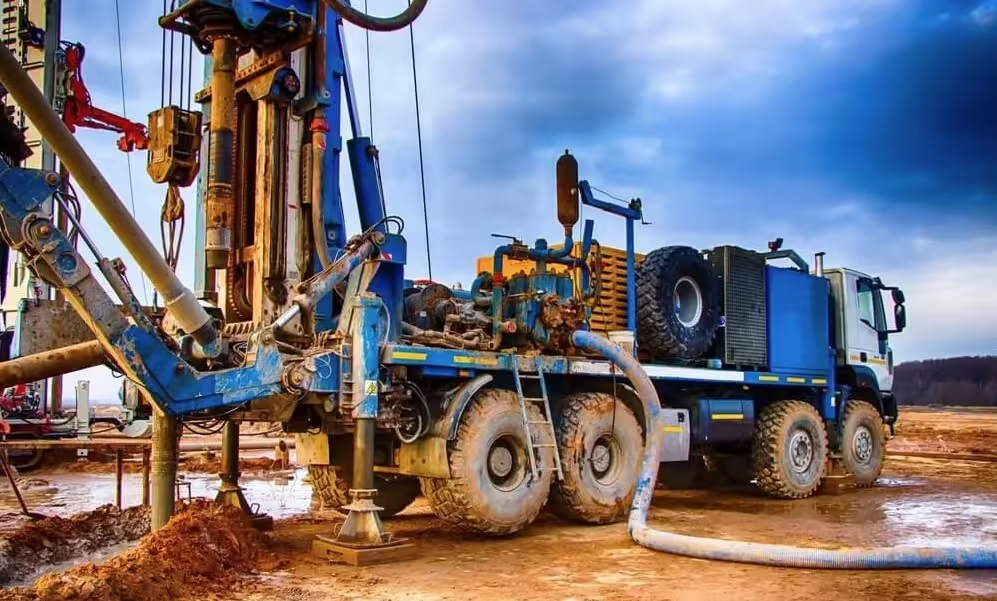
Reliable Borehole Water-Supply Solutions
Perfect Solution Contracting Company provides engineering coordination, equipment selection, installation, testing, commissioning, and maintenance support for borehole water-supply systems.
A properly developed system must consider the available groundwater yield, required water demand, borehole depth, pumping level, water quality, storage capacity, operating pressure, energy supply, and applicable environmental and regulatory requirements.
Site and Water-Demand Assessment
Borehole development should begin with a review of the site, intended water use, estimated daily demand, and available hydrogeological information. Specialist investigation may be required to determine suitable drilling locations and expected groundwater conditions.
- Review of the intended water application.
- Estimation of average and peak water demand.
- Review of available groundwater and site information.
- Coordination of hydrogeological and geophysical studies.
- Review of access, power, drainage, and equipment locations.
- Coordination of required permits and authority approvals.
Borehole Construction Coordination
Borehole construction details are developed by qualified specialists according to geological conditions, anticipated depth, casing requirements, aquifer protection, and the results of drilling and testing.
- Borehole depth and diameter coordination.
- Casing, screen, and gravel-pack requirements.
- Sanitary sealing and groundwater protection.
- Wellhead protection and surface completion.
- Borehole development and cleaning.
- Pumping and recovery testing.
Pump and Rising-Main Selection
The borehole pump is selected according to the tested yield, dynamic water level, required flow, total head, pipe losses, storage arrangement, and desired operating pressure. The selected flow rate should remain within the sustainable capacity established during testing.
- Submersible borehole pumps.
- Rising mains and discharge pipework.
- Non-return and isolation valves.
- Pressure gauges and flow meters.
- Borehole-level sensors and dry-run protection.
- Pump cables, supports, and wellhead connections.
Storage and Distribution
The extracted water may be transferred to a storage tank before treatment or distribution. Storage volume and pumping controls are selected according to demand, borehole recovery, operating schedule, and the required emergency reserve.
- Ground-level and elevated water-storage tanks.
- Transfer pumps and pressure-boosting systems.
- Internal and external distribution networks.
- Tank-level controls and overflow arrangements.
- Irrigation and service-water connections.
- Metering and water-consumption monitoring.
Water Quality and Treatment
Borehole water should be analysed before selecting the treatment process or approving its intended use. Treatment requirements depend on the measured physical, chemical, and microbiological characteristics of the water.
- Water sampling and laboratory analysis coordination.
- Sediment and multimedia filtration.
- Iron, manganese, and hardness treatment where required.
- Chemical dosing and disinfection.
- Reverse-osmosis systems where appropriate.
- Treated-water tanks and distribution connections.
Electrical and Control Systems
- Pump control and protection panels.
- Variable-frequency drives where appropriate.
- Automatic start and stop controls.
- Low-water-level and dry-run protection.
- Tank-level and pressure-control interfaces.
- Alarm, fault, and remote-monitoring functions.
- Solar-powered pumping solutions where suitable.
Testing and Commissioning
Commissioning activities may include pump testing, verification of flow and pressure, water-level monitoring, valve and control testing, inspection of electrical protection, leakage checks, and confirmation of storage and treatment operation.
Sustainable Operation
Groundwater extraction must be managed responsibly. Pumping rates and schedules should follow the results of the approved testing and the conditions established by the relevant authorities to help protect the borehole and groundwater resource.