
Integrated Compressed-Air Generation and Distribution
Perfect Solution Contracting Company provides design, supply, installation, testing, commissioning, and maintenance services for compressed-air systems in industrial facilities, workshops, warehouses, laboratories, and service buildings.
Each system is designed to provide the pressure, airflow, and air quality required by the connected equipment while minimising pressure losses, leakage, energy consumption, and maintenance requirements.
Compressed-Air System Components
- Reciprocating and rotary-screw air compressors.
- Compressed-air receiver and storage tanks.
- Refrigerated and desiccant air dryers.
- Particulate, oil-removal, and moisture filters.
- Moisture separators and automatic condensate drains.
- Pressure regulators, control valves, and safety valves.
- Main and branch distribution pipework.
- Point-of-use connections and air-preparation units.
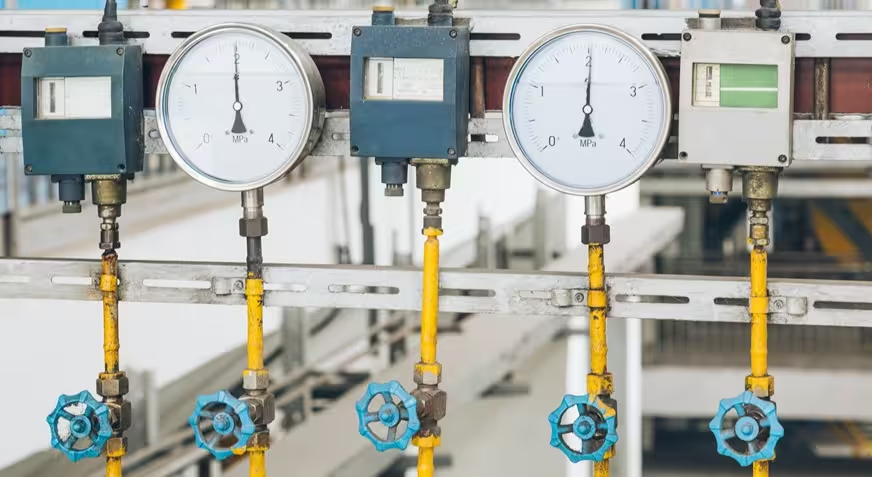
- Control panels, measuring instruments, and monitoring devices.
Distribution-Network Design
Compressed-air network design requires assessment of the required airflow, operating pressure, acceptable pressure drop, number of points of use, demand variation, and provision for future expansion.
- Calculation of current and future air demand.
- Verification of pressure at the furthest point of use.
- Pipe sizing to reduce excessive pressure loss.
- Ring-main or branch network design as appropriate.
- Provision of isolation, drainage, and maintenance points.
- Allowance for future equipment and network extensions.
Compressed-Air Quality
Air-quality requirements vary according to the application. Some processes require higher levels of moisture, oil, and particle removal than general industrial applications. Dryers, filters, and condensate-management equipment are therefore selected according to the required air quality.
For sensitive applications such as laboratories, food processing, or pharmaceutical facilities, purity and dryness requirements are reviewed against the project specification and the applicable process requirements.
Energy Efficiency
Air leaks, excessive operating pressure, incorrectly selected equipment, and blocked filters can significantly increase electricity consumption. Correct design and regular monitoring help improve efficiency and reduce operating costs.
- Detection and repair of compressed-air leaks.
- Adjustment of pressure to actual operating requirements.
- Scheduled cleaning or replacement of filters.
- Variable-speed compressor control where suitable.
- Monitoring of pressure, airflow, and energy consumption.
Testing and Commissioning
Testing activities include inspection of the pipework, leakage testing, verification of pressure and airflow, and functional checks of compressors, dryers, filters, valves, controls, and condensate drainage equipment.
The completed system is adjusted and commissioned according to approved drawings, project specifications, operating requirements, and manufacturer instructions.
Preventive Maintenance
- Inspection of compressors, motors, and cooling systems.
- Replacement of oils, filters, and separators when required.
- Inspection of dryers and condensate drains.
- Testing of safety valves and measuring instruments.
- Inspection of receiver tanks, pipework, and connections.
- Recording of operating readings, defects, and completed repairs.