
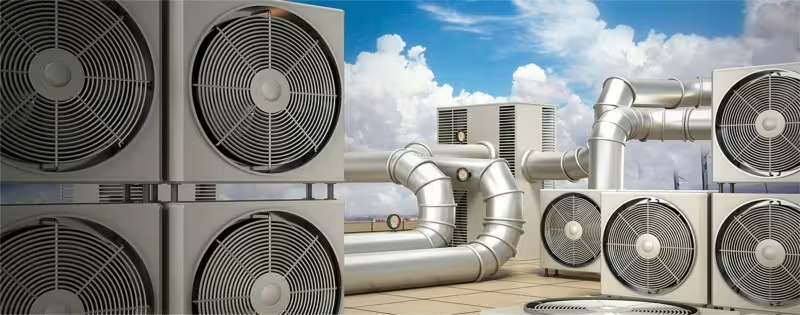
HVAC Operation & Maintenance Services
Perfect Solution Contracting provides Heating, Ventilation and Air Conditioning (HVAC) operation and maintenance services as part of integrated facility management for commercial, government, residential, industrial, and specialised facilities.
HVAC systems can include chillers, air handling units, fan coil units, package units, split systems, VRF/VRV systems, pumps, cooling towers, ventilation fans, ductwork, chilled-water networks, controls, sensors, and Building Management System (BMS) interfaces.
Effective HVAC facility management requires more than responding to cooling complaints. It involves planned operation, preventive maintenance, condition monitoring, corrective maintenance, control-system coordination, performance review, documentation, and appropriate specialist support.
Maintenance requirements should be based on the installed equipment, manufacturer recommendations, operating hours, environmental conditions, asset criticality, maintenance history, approved technical procedures, and the agreed facility-management scope.
HVAC System Operation
HVAC operation involves monitoring and controlling equipment according to the building's operating requirements, occupancy schedules, approved setpoints, system configuration, and environmental conditions.
Operational activities can include equipment status monitoring, temperature review, alarm follow-up, scheduling, operating-mode checks, and coordination between central plant and terminal equipment.
Preventive Maintenance
Planned Preventive Maintenance (PPM) helps identify deterioration and service requirements before they develop into more significant equipment problems.
Preventive maintenance schedules can include inspections, cleaning, lubrication where applicable, filter servicing, electrical checks, control checks, measurement of operating parameters, and replacement of scheduled consumables.
The frequency and content of maintenance activities should reflect the specific equipment and manufacturer recommendations rather than applying one maintenance schedule to every HVAC asset.
Corrective Maintenance
Corrective maintenance addresses identified faults, abnormal operation, equipment failures, leakage, control problems, electrical issues, excessive noise, vibration, insufficient cooling or heating, and other HVAC defects.
Fault diagnosis should consider the complete system because a temperature or airflow problem can originate from several different mechanical, electrical, hydraulic, air-distribution, or control conditions.
Chiller Operation & Maintenance
Chillers are commonly used in central cooling systems to produce chilled water for air-conditioning equipment throughout a facility.
Chiller maintenance can include review of operating parameters, temperatures, pressures, alarms, electrical condition, controls, refrigerant-system indications, heat-transfer surfaces, water flow, and other manufacturer-specific requirements.
Chiller maintenance should follow the equipment manufacturer's procedures, particularly where specialist refrigeration work, internal servicing, refrigerant handling, or proprietary controls are involved.
Air-Cooled Chillers
Air-cooled chillers reject heat through outdoor coils and fans and require appropriate airflow around the equipment.
Maintenance can include inspection of condenser coils, fans, motors, electrical components, controls, accessible refrigerant-system components, and general equipment condition.
Dirty or obstructed condenser surfaces can affect heat rejection, so coil condition and surrounding airflow should be considered within the maintenance programme.
Water-Cooled Chillers
Water-cooled chiller installations normally form part of a larger system involving chilled-water pumps, condenser-water pumps, cooling towers, piping, valves, controls, and water-treatment requirements.
Maintenance should therefore consider the complete cooling plant rather than evaluating the chiller in isolation.
Cooling Tower Maintenance
Cooling towers used in water-cooled HVAC systems require scheduled inspection and maintenance of components such as fans, motors, drives, fill, basins, strainers, distribution systems, controls, and associated water systems.
Water quality and water-treatment programmes should be managed by appropriately qualified personnel according to the system requirements and applicable procedures.
Chilled Water Pumps
Chilled-water pumps circulate water between cooling equipment and building loads. Pump maintenance can include inspection for leakage, abnormal noise, vibration, bearing condition, seals, couplings, motors, electrical connections, and operating parameters.
Pump operation should be considered together with system pressure, flow, valve positions, differential pressure, control strategy, and the overall chilled-water network.
Condenser Water Pumps
Water-cooled chiller plants may also use condenser-water pumps to circulate water between chillers and cooling towers.
Their maintenance requirements are similar in principle to other HVAC pumps but should reflect the actual equipment configuration and operating environment.
Air Handling Units (AHUs)
Air Handling Units condition and distribute air through building ductwork and may include filters, cooling or heating coils, fans, dampers, sensors, humidification components, heat-recovery equipment, and controls depending on the system design.
AHU maintenance can include filter servicing, coil inspection and cleaning, drain-pan inspection, fan and motor checks, belt inspection where applicable, damper checks, sensor review, and general internal and external condition inspection.
Fan Coil Units (FCUs)
Fan Coil Units are commonly installed within individual rooms or zones and may require regular filter cleaning or replacement, coil inspection, drain-pan cleaning, condensate-drain checks, fan and motor inspection, valve checks, and thermostat or controller review.
Water leakage or blocked condensate drainage around FCUs should be investigated promptly because it can affect ceilings, finishes, furniture, and adjacent building areas.
Package Units
Packaged HVAC units combine multiple cooling and air-handling components within a packaged assembly and are commonly used in various commercial and operational facilities.
Maintenance may include filters, coils, fans, compressors, electrical components, controls, condensate systems, belts where installed, and other equipment-specific components.
Split & Ducted Split Systems
Split and ducted split systems can include indoor and outdoor units connected through refrigerant piping and electrical/control systems.
Maintenance can include filter cleaning, evaporator and condenser coil inspection, condensate drainage, electrical checks, fan inspection, control checks, and review of operating condition.
VRF & VRV Systems
Variable Refrigerant Flow systems use refrigerant networks and electronic controls to serve multiple indoor units from one or more outdoor units.
Maintenance can involve indoor and outdoor unit inspections, filters, coils, condensate systems, communication networks, electronic controls, alarms, and refrigerant-system diagnostics.
Specialist diagnostic tools or manufacturer support may be required for certain VRF/VRV faults and proprietary control functions.
Ventilation Systems
Mechanical ventilation systems provide outdoor air, extract air, or support air movement within selected building areas according to the approved design.
Ventilation maintenance can include supply fans, exhaust fans, dampers, filters, belts, motors, controls, ductwork interfaces, and associated components.
Fresh Air Systems
Fresh-air systems should operate according to the building design, occupancy requirements, control strategy, and facility operating conditions.
Filters, dampers, fans, coils, sensors, and control sequences can be included within the planned maintenance programme according to the installed equipment.
Exhaust & Extract Systems
Exhaust systems may serve toilets, kitchens, service rooms, parking areas, technical spaces, or other locations depending on the building design.
Maintenance requirements depend on the application and can include fans, motors, belts, dampers, controls, accessible ductwork components, and associated electrical equipment.
Ductwork & Air Distribution
Ductwork distributes conditioned, fresh, return, or exhaust air throughout the facility and should remain appropriately supported and connected.
Visible ductwork inspections can identify damaged insulation, loose flexible connections, damaged access panels, air leakage indications, or other conditions requiring maintenance.
Diffusers, Grilles & Registers
Diffusers and grilles influence air distribution within occupied spaces and can accumulate dust or become damaged, obstructed, or incorrectly adjusted.
Accessible surface cleaning and visual inspection can be included within routine maintenance, while airflow balancing requires appropriate testing and adjustment procedures.
HVAC Filters
Filters help control particulate contamination within air-handling systems and protect downstream equipment according to their type and application.
Filters should be inspected, cleaned where designed for cleaning, or replaced according to their condition, pressure-drop criteria where monitored, manufacturer recommendations, and the facility maintenance plan.
Cooling Coil Cleaning
Cooling coils require suitable airflow and heat transfer to perform their intended function. Dirt accumulation can affect these conditions.
Coil cleaning methods should be compatible with the coil material and equipment construction and should avoid damaging fins, coatings, electrical components, or surrounding equipment.
Condensate Drainage
Cooling equipment produces condensate that must be drained appropriately from the unit.
Drain pans, traps, piping, and accessible drainage components should be inspected and maintained to reduce the risk of blockage, overflow, or water leakage.
Refrigeration System Checks
Refrigeration systems can include compressors, evaporators, condensers, expansion devices, refrigerant piping, valves, sensors, and controls depending on the equipment.
Refrigerant-related work should be performed by appropriately qualified personnel using suitable equipment and following the applicable manufacturer, safety, and environmental requirements.
Refrigerant Leak Investigation
Suspected refrigerant loss should be investigated rather than routinely adding refrigerant without identifying the reason for the loss.
Leak investigation and repair should follow appropriate procedures before the system is returned to its intended operating condition.
Compressor Maintenance
Compressors are critical components of many refrigeration and air-conditioning systems. Maintenance requirements vary according to compressor type and equipment design.
Operating parameters, electrical condition, alarms, temperatures, pressures, oil condition where applicable, and other manufacturer-specific requirements can be reviewed as part of the maintenance programme.
HVAC Electrical Systems
HVAC equipment depends on electrical components such as motors, isolators, contactors, overload protection, circuit breakers, control transformers, drives, starters, sensors, and control wiring.
Electrical inspections should be performed using appropriate isolation and electrical safety procedures by qualified personnel.
Variable Frequency Drives (VFDs)
Variable Frequency Drives may be used to control the speed of HVAC pumps, fans, cooling towers, and other motor-driven equipment.
Maintenance can include inspection of alarms, cooling paths, fans, electrical connections, operating parameters, and communication with the control system where applicable.
HVAC Controls
HVAC controls can include thermostats, temperature sensors, pressure sensors, differential-pressure transmitters, actuators, valves, dampers, controllers, and communication networks.
Control problems can affect equipment operation even when the main mechanical components remain functional, so controls should be considered during HVAC fault diagnosis.
Building Management System (BMS) Integration
HVAC systems are commonly integrated with Building Management Systems to support central monitoring, scheduling, alarm management, setpoint supervision, trending, and equipment status monitoring.
The BMS can provide useful operational information, but it does not replace physical inspection, preventive maintenance, equipment-specific diagnostics, or specialist servicing.
Available BMS functions depend on the installed controls, sensors, communication protocols, software, point list, and approved integration scope.
Temperature Monitoring
Indoor temperature monitoring can help facility teams identify abnormal conditions, recurring complaints, or differences between occupied zones.
Temperature problems should be evaluated together with equipment operation, airflow, water flow, controls, occupancy, heat loads, building envelope conditions, and other relevant factors.
Humidity Monitoring
Where humidity control forms part of the HVAC design, indoor relative humidity can be monitored as an operational parameter.
Actual humidity performance depends on system design, outdoor conditions, ventilation rates, internal moisture loads, controls, and equipment capability.
Indoor Air Quality Support
HVAC operation can influence indoor environmental conditions through ventilation, filtration, temperature, humidity control where provided, and air distribution.
Indoor air quality is affected by multiple factors and should not be attributed to HVAC maintenance alone. Building occupancy, pollutant sources, housekeeping, outdoor air quality, ventilation design, filtration, and other conditions may also be relevant.
Airflow Assessment
Where airflow problems are suspected, appropriate measurements can be used to assess system performance and identify potential distribution issues.
Formal testing, adjusting, and balancing should be performed using appropriate instruments and procedures when required by the project or corrective-maintenance scope.
Testing, Adjusting & Balancing
Testing, Adjusting and Balancing (TAB) may be required following major modifications, equipment replacement, system changes, or where significant airflow or hydronic-balance issues are identified.
TAB activities should be based on the approved system design and performed using suitable calibrated instruments and documented procedures.
Chilled Water System Monitoring
Central chilled-water systems require coordination between chillers, pumps, control valves, terminal units, differential-pressure controls, piping networks, and other system components.
Supply and return temperatures, operating pressures, flow conditions where measured, equipment staging, and valve operation can provide useful information when assessing plant performance.
Water Treatment Coordination
Chilled-water and condenser-water systems may require water-treatment programmes according to the system configuration and operating requirements.
Chemical treatment, water analysis, dosing, and related specialist activities should be carried out by appropriately qualified personnel according to the approved programme.
HVAC Insulation
HVAC insulation may be installed on chilled-water piping, ducts, equipment, valves, and other components to control heat transfer and, where applicable, condensation.
Damaged or missing insulation and vapour barriers can be identified during maintenance inspections and referred for appropriate repair.
Noise & Vibration
Abnormal noise or vibration can indicate mechanical, installation, airflow, hydraulic, or operational conditions requiring investigation.
Inspection may consider bearings, fans, pumps, motors, belts, couplings, supports, isolation mounts, airflow, cavitation indications, and other equipment-specific factors.
Belt & Drive Inspection
Belt-driven fans and other HVAC equipment require inspection of belt condition, tension, alignment, pulleys, guards, and associated drive components.
Replacement and adjustment should follow the equipment manufacturer's requirements and appropriate isolation procedures.
Bearing & Motor Inspection
Motors and bearings should be monitored for abnormal noise, vibration, temperature, lubrication requirements where applicable, and other visible or measurable signs of deterioration.
Electrical and mechanical findings should be evaluated together where necessary to determine the cause of abnormal equipment operation.
Valve & Actuator Inspection
HVAC systems can contain isolation valves, balancing valves, control valves, actuators, and other flow-control devices.
Maintenance can include checking for leakage, physical damage, abnormal operation, actuator response, and control-system interaction according to the installed configuration.
Damper Inspection
HVAC dampers can regulate outdoor air, return air, supply air, exhaust air, or zone airflow depending on the system.
Damper operation, actuator response, linkage condition, accessibility, and control signals can be reviewed where included within the maintenance scope.
Fire & Smoke Damper Coordination
Fire and smoke dampers form part of the building's fire and life-safety strategy and should not be treated as ordinary HVAC balancing dampers.
Inspection and testing should be coordinated with the relevant fire and life-safety requirements, approved procedures, and appropriately qualified personnel.
Kitchen Ventilation Coordination
Commercial kitchen ventilation can include extract hoods, fans, ductwork, make-up air systems, controls, filters, and associated fire-safety interfaces.
Grease-related cleaning and specialist kitchen-extract requirements should be managed according to the specific system, operating conditions, and applicable procedures.
Car Park Ventilation
Enclosed parking areas may use mechanical ventilation systems controlled according to the building design and operating strategy.
Maintenance can include fans, motors, drives, controls, sensors, dampers, and associated electrical systems depending on the installed arrangement.
Smoke Control Interface Coordination
Some HVAC and ventilation equipment may interface with smoke-control or fire alarm systems according to the approved building design.
Functional testing of these interfaces should be coordinated between HVAC, fire alarm, BMS, electrical, and other relevant specialist teams.
HVAC Fault Diagnosis
Effective troubleshooting requires identifying the root cause of the problem rather than responding only to the visible symptom.
Diagnostic activities can include reviewing alarms, equipment status, temperature and pressure readings, electrical measurements, control signals, airflow, chilled-water conditions, refrigerant-system behaviour, and maintenance history.
HVAC Alarm Management
HVAC alarms generated by local controllers or the BMS should be reviewed and investigated according to their operational significance.
Repeated alarms can be analysed together with equipment history to identify recurring faults or operating conditions requiring corrective action.
Emergency HVAC Response
Critical HVAC failures can affect occupied areas, technical rooms, sensitive equipment, or other important facility functions.
Response priorities should be established according to safety, asset criticality, operational impact, facility requirements, and the applicable service agreement.
Spare Parts & Consumables
HVAC maintenance may require filters, belts, bearings, sensors, actuators, valves, contactors, relays, thermostats, seals, motors, and other components depending on the installed equipment.
Replacement parts should be selected according to technical compatibility, approved specifications, and manufacturer requirements where applicable.
Critical Spare Parts Planning
Critical HVAC assets can be reviewed to identify spare parts that may warrant planned availability based on equipment criticality, failure history, lead times, manufacturer support, and operational requirements.
Spare-parts planning should balance asset risk, availability requirements, storage conditions, cost, and procurement lead time.
Energy Performance Monitoring
HVAC systems can represent a significant portion of a building's energy use. Operational data can therefore be reviewed to identify abnormal operating schedules, simultaneous operation, inappropriate setpoints, or other potential optimisation opportunities.
Actual energy savings depend on system design, building use, equipment condition, control strategy, climate, operating hours, and the implemented improvement measures; savings should therefore be verified rather than assumed.
HVAC Scheduling & Setpoint Review
Equipment schedules and temperature setpoints can be reviewed against occupancy patterns and approved operational requirements.
Changes should consider occupant needs, humidity requirements where applicable, equipment limitations, process loads, ventilation requirements, and the overall building control strategy.
Trend Analysis
Where suitable data is available through the BMS or equipment controllers, trends can support analysis of temperatures, setpoints, equipment status, valve positions, pressures, alarms, and other operating parameters.
Trend data can assist troubleshooting and operational review but should be interpreted together with physical inspection and knowledge of the actual system.
Asset Condition Assessment
HVAC asset condition can be assessed using maintenance history, operating performance, physical inspection, breakdown frequency, equipment age, spare-parts availability, and specialist findings.
Condition information can support maintenance planning, budgeting, repair-versus-replacement evaluations, and longer-term asset lifecycle decisions.
Equipment Replacement & Modernisation
HVAC equipment may eventually require major repair, refurbishment, or replacement because of deterioration, repeated failures, obsolescence, changing facility requirements, or limited technical support.
Replacement planning should consider actual cooling or heating requirements, system compatibility, electrical requirements, controls, piping or ductwork interfaces, installation constraints, access, shutdowns, and commissioning requirements.
Testing & Commissioning Support
New or modified HVAC equipment should be inspected and tested according to the approved project requirements before normal operation.
Depending on the scope, commissioning can include equipment functional checks, control sequences, temperatures, pressures, airflow, water flow, alarms, interlocks, BMS points, and other relevant operating parameters.
Shutdown Coordination
HVAC maintenance and replacement activities may require temporary shutdown of equipment or services.
Planned shutdowns should be coordinated with facility representatives and affected users, particularly where HVAC systems serve critical or continuously occupied areas.
Maintenance Documentation
HVAC maintenance records provide an important history of inspections, preventive maintenance, corrective work, measurements, faults, replaced components, and equipment condition.
Documentation may include maintenance checklists, service reports, test results, photographs, readings, alarm information, spare-parts records, and recommended follow-up actions.
CAFM & CMMS Integration
HVAC assets can be registered and managed through Computer-Aided Facility Management (CAFM) or Computerised Maintenance Management Systems (CMMS) where these platforms form part of the facility operation.
Asset records can include equipment identification, location, manufacturer, model, serial number, capacity, maintenance schedule, work orders, fault history, readings, spare parts, and associated documentation.
Work Order Management
Planned and reactive HVAC activities can be managed through work orders containing the asset, location, reported issue, assigned technician, priority, maintenance activity, materials, findings, completion status, and other required information.
Work-order histories can support analysis of recurring failures and provide useful information for asset condition and maintenance planning.
SLA & KPI Monitoring
HVAC maintenance contracts can include Service Level Agreements (SLAs) and Key Performance Indicators (KPIs) for agreed response, attendance, planned maintenance, work-order completion, and other operational requirements.
Performance targets should be based on the applicable contract and facility requirements rather than applying universal guarantees to every HVAC system.
Health, Safety & Environment
HVAC maintenance can involve electrical systems, rotating machinery, refrigerants, chemicals, pressurised systems, hot surfaces, confined areas, work at height, lifting activities, and other hazards.
Work should be performed by appropriately qualified personnel using the applicable permits, isolation procedures, personal protective equipment, tools, and approved work methods.
HVAC Operation & Maintenance Scope
- HVAC system operation
- Planned preventive maintenance
- Corrective maintenance
- Chiller maintenance
- Air-cooled chiller maintenance
- Water-cooled chiller maintenance
- Cooling tower maintenance
- Chilled-water pump maintenance
- Condenser-water pump maintenance
- AHU maintenance
- FCU maintenance
- Package-unit maintenance
- Split and ducted split maintenance
- VRF and VRV system maintenance
- Ventilation system maintenance
- Fresh-air system maintenance
- Exhaust and extract systems
- Ductwork inspections
- Diffuser and grille inspections
- Filter cleaning and replacement
- Cooling-coil cleaning
- Condensate drainage maintenance
- Refrigeration system checks
- Refrigerant leak investigation
- Compressor condition monitoring
- HVAC electrical inspections
- VFD inspection and monitoring
- HVAC controls maintenance
- BMS integration and monitoring
- Temperature and humidity monitoring
- Indoor air quality support
- Airflow assessment
- TAB coordination where required
- Chilled-water system monitoring
- Water-treatment coordination
- HVAC insulation inspections
- Noise and vibration investigation
- Valve and actuator inspections
- Damper inspections
- Fire and smoke damper coordination
- HVAC fault diagnosis
- HVAC alarm management
- Emergency HVAC response
- Spare-parts coordination
- Critical spare-parts planning
- Energy performance monitoring
- Operating schedule review
- BMS trend analysis
- Asset condition assessment
- Equipment replacement planning
- Testing and commissioning support
- Shutdown coordination
- Maintenance documentation
- CAFM and CMMS records
- Work-order management
- SLA and KPI monitoring
Integrated HVAC Facility Management
Reliable HVAC operation depends on coordination between mechanical equipment, electrical systems, controls, chilled-water networks, air distribution, ventilation, BMS, water treatment, maintenance personnel, and the operational requirements of the building.
Perfect Solution Contracting provides coordinated HVAC operation and maintenance services covering planned maintenance, fault response, equipment monitoring, controls, asset records, work orders, performance review, and technical coordination according to the installed systems and agreed facility-management scope.