
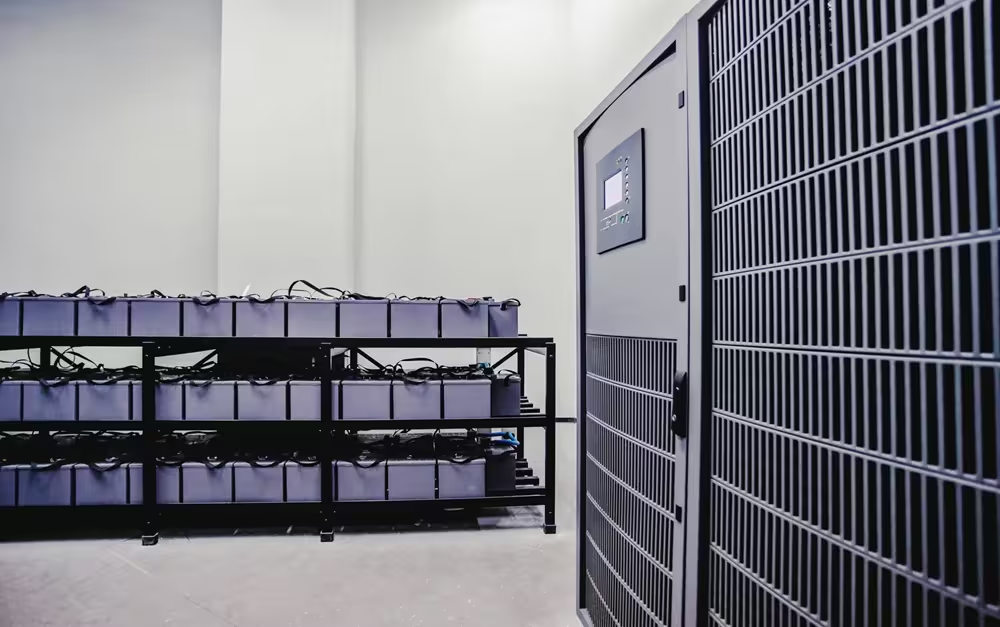
UPS & Lighting System Maintenance Services
Perfect Solution Contracting provides UPS and lighting system operation and maintenance support as part of integrated facility management services for commercial, government, residential, industrial, administrative, and other managed facilities.
Uninterruptible Power Supply (UPS) systems and lighting installations perform different functions within a building electrical system. A UPS provides temporary battery-backed electrical power to designated critical loads during certain supply interruptions, while lighting systems provide illumination for normal operation, circulation, tasks, safety, and other building requirements.
Effective maintenance requires coordinated inspection of UPS equipment, batteries, electrical connections, bypass arrangements, protection, monitoring systems, luminaires, lighting circuits, emergency lighting, controls, sensors, and associated electrical distribution.
Maintenance activities should follow the approved electrical design, equipment manufacturer recommendations, applicable safety requirements, operating procedures, and contractual scope.
Uninterruptible Power Supply Systems
UPS systems provide short-term electrical support to designated loads when the normal power supply is interrupted or falls outside conditions that the UPS is designed to manage.
Depending on the UPS topology and configuration, the system may also provide certain power-conditioning functions. However, a UPS should not be assumed to correct every possible power-quality problem.
UPS System Configuration
UPS installations can vary considerably according to load requirements, required autonomy, redundancy, electrical architecture, criticality, and facility operating requirements.
Configurations can include standalone units, modular UPS systems, parallel systems, redundant arrangements, centralised systems, and distributed UPS equipment.
Online Double-Conversion UPS
Online double-conversion UPS systems normally convert incoming AC power to DC and then convert DC back to AC through the inverter to supply the connected load during normal online operation.
The exact operating modes and transfer arrangements depend on the manufacturer and system configuration.
UPS Rectifier & Charger
The rectifier converts incoming AC power to DC for the UPS DC bus and battery-charging functions according to the equipment design.
Maintenance can include monitoring alarms, operating parameters, ventilation, connections, and equipment condition according to manufacturer requirements.
UPS Inverter
The inverter converts DC power into AC power for the connected load during the applicable UPS operating modes.
Inverter alarms, abnormal output conditions, overload indications, temperature alarms, and other reported conditions should be investigated according to the system documentation.
UPS Batteries
Batteries provide stored energy that allows the UPS to support designated loads when the normal electrical source is unavailable within the designed operating conditions.
Available runtime depends on battery capacity, battery condition, age, temperature, connected load, UPS efficiency, discharge characteristics, and the original system design.
Battery Inspection
Routine battery inspections can include checks for visible swelling, leakage, corrosion, damaged connections, abnormal temperature, loose components, alarms, and other signs of deterioration.
Battery testing and interpretation should follow the battery technology, manufacturer recommendations, approved procedures, and appropriate safety requirements.
Battery Monitoring
Some UPS installations include battery-monitoring systems that provide information about individual blocks, strings, temperatures, voltages, or other supported parameters.
Monitoring can support condition assessment but does not replace appropriate physical inspection and required maintenance.
UPS Battery Runtime
Battery runtime should not be treated as a fixed value independent of operating conditions.
Changes in connected load, battery condition, temperature, battery age, configuration, and equipment performance can affect actual autonomy.
Static Bypass
A static bypass can provide an alternative electrical path to the load under defined UPS conditions, such as certain faults or overload conditions, depending on the system design.
The static bypass is not an independent backup power source and normally depends on the availability and suitability of the bypass electrical supply.
Maintenance Bypass
A maintenance bypass arrangement may allow designated UPS equipment to be isolated for maintenance while the load is supplied through an alternative electrical path, subject to the approved design.
Switching operations should only be performed using the approved procedure by qualified and authorised personnel because incorrect operation can affect critical loads.
UPS Input Supply
The UPS input supply should be considered together with upstream electrical distribution, circuit protection, cabling, isolation, earthing, and source characteristics.
Abnormal input conditions should be investigated in coordination with the electrical distribution system.
UPS Output Distribution
UPS output can supply critical distribution boards, equipment, control systems, IT infrastructure, or other designated loads according to the approved design.
Output loading and distribution should remain within equipment ratings and the intended electrical architecture.
UPS Load Monitoring
Monitoring UPS loading can help identify overload, phase imbalance where applicable, unexpected load growth, and changes in available battery runtime.
Capacity should be evaluated using the relevant kVA, kW, power factor, redundancy, and manufacturer limitations rather than relying on a single rating.
UPS Redundancy
Critical installations may use redundant UPS modules or parallel configurations according to the approved electrical design.
Redundancy can improve system resilience when correctly designed and maintained, but it does not eliminate the need for maintenance or remove all possible single points of failure.
UPS Alarm Monitoring
UPS systems can generate alarms relating to batteries, input supply, bypass conditions, overload, temperature, fans, modules, communication, or other equipment conditions.
Alarms should be investigated according to their cause and priority rather than repeatedly cleared without appropriate diagnosis.
UPS Display & Event Logs
UPS displays and event logs can provide useful information about current status, operating modes, warnings, alarms, and historical events.
Event history can support troubleshooting and recurring fault analysis when reviewed together with actual site conditions.
UPS Cooling & Ventilation
UPS equipment and batteries can be sensitive to environmental conditions and require suitable ventilation or cooling according to the installed system.
Room temperature, ventilation, equipment clearances, dust accumulation, and HVAC condition should therefore be considered as part of facility maintenance.
UPS Room Inspection
UPS and battery rooms can be inspected for housekeeping, temperature, ventilation, access, lighting, water leakage, equipment clearance, electrical safety, and other relevant conditions.
Materials should not be stored where they obstruct equipment, ventilation openings, electrical panels, emergency routes, or maintenance access.
Electrical Connections
Electrical connections associated with UPS equipment should be inspected and maintained according to approved electrical procedures.
Any intrusive inspection, tightening, testing, or thermographic investigation should be planned with the appropriate safety controls and qualified personnel.
UPS Preventive Maintenance
Planned Preventive Maintenance (PPM) can include equipment inspection, alarm review, battery assessment, fan inspection, environmental checks, electrical observations, cleaning where appropriate, and functional verification.
The actual maintenance scope and frequency should follow manufacturer recommendations, equipment condition, operating environment, system criticality, and the maintenance contract.
UPS Functional Testing
Functional tests can verify selected UPS operating modes and system responses according to approved procedures.
Testing involving critical loads, source transfers, bypass operation, or battery discharge should be carefully planned to manage operational risk.
Battery Testing
Battery condition can be evaluated using suitable inspection and testing methods appropriate to the installed battery technology.
Test results should be trended where appropriate because deterioration over time can be more informative than a single isolated measurement.
Load Bank Testing
Where required, controlled load testing can be used to evaluate UPS or battery performance under defined conditions.
Load-bank testing should be planned and performed by qualified personnel using suitable equipment and an approved method statement.
UPS Corrective Maintenance
Corrective maintenance addresses UPS faults identified through alarms, inspections, testing, monitoring, or operational reports.
Specialist manufacturer or authorised technical support may be required for internal power electronics, firmware, control boards, inverter modules, rectifiers, or other specialised components.
Generator & UPS Coordination
In standby power systems, the UPS and generator perform different but complementary functions.
The UPS can provide immediate battery-backed support while the generator starts and becomes available for longer-duration standby operation, subject to the approved electrical design and available capacity.
Generator Compatibility
UPS operation with generator supplies can require consideration of generator capacity, voltage and frequency behaviour, harmonic loading, UPS input characteristics, charging demand, and system configuration.
Compatibility should be assessed as part of the electrical design rather than assumed.
UPS Monitoring & BMS Integration
Selected UPS status points and alarms can be integrated with a Building Management System (BMS) or other monitoring platform where supported by the installed equipment and approved design.
BMS monitoring does not replace the UPS controller, manufacturer diagnostics, physical inspection, or specialist maintenance.
Lighting Systems
Building lighting systems include luminaires, lamps or LED modules, drivers, control devices, switches, sensors, wiring, circuits, distribution boards, and associated mounting components depending on the installation.
Lighting maintenance should consider both illumination performance and the electrical condition of the associated system.
Interior Lighting
Interior lighting can serve offices, corridors, staircases, reception areas, technical rooms, service areas, parking facilities, and other occupied or operational spaces.
Maintenance requirements vary according to the luminaire type, operating hours, environmental conditions, accessibility, and control system.
Exterior Lighting
Exterior lighting can include building perimeter lighting, entrances, pathways, landscape areas, parking areas, service yards, and other external locations.
Outdoor equipment should be suitable for the installed environment and inspected for physical damage, water ingress, mounting condition, and electrical faults.
LED Lighting Systems
LED installations can include integrated luminaires, replaceable lamps, LED modules, drivers, control components, and associated accessories.
LED failure can result from the light source, driver, electrical supply, connection, control system, temperature, or other factors and should be diagnosed accordingly.
Lighting Drivers
LED drivers regulate electrical power supplied to LED modules and are a common component in modern lighting systems.
Flickering, intermittent operation, reduced output, or complete failure can require investigation of the driver, LED module, supply, controls, and connections.
Lighting Circuit Inspection
Lighting circuits can be inspected for reported faults, abnormal tripping, damaged accessories, defective luminaires, loose components, or other visible issues.
Electrical testing and repair should be performed by qualified personnel under appropriate isolation and safety procedures.
Luminaire Maintenance
Luminaire maintenance can include cleaning, inspection, lamp or component replacement where applicable, mounting checks, diffuser inspection, and corrective repair.
Replacement components should be compatible with the existing luminaire and electrical system.
Lighting Fixture Cleaning
Dust and contamination can affect light output and the condition of accessible luminaires.
Cleaning should use methods compatible with the fixture materials and should be coordinated with electrical isolation where required.
Lighting Switches
Switches and associated wiring accessories can be inspected for physical damage, loose mounting, overheating indications, abnormal operation, or other visible defects.
Replacement should use appropriately rated and compatible devices.
Occupancy & Motion Sensors
Occupancy and motion sensors can automatically control selected lighting circuits according to detected activity and configured settings.
Sensor performance can be affected by location, obstruction, sensitivity settings, time delays, configuration, and equipment condition.
Daylight Sensors
Daylight sensors can adjust or switch selected lighting according to measured ambient light where the control strategy supports this function.
Sensors and control settings should be checked where occupants report inappropriate switching or dimming.
Lighting Control Systems
Lighting control systems can range from conventional switches and timers to programmable controllers, dimming systems, sensors, relays, contactors, and networked lighting platforms.
Maintenance should consider both field devices and the associated control logic or communication system.
DALI Lighting Controls
Digital Addressable Lighting Interface (DALI) systems may be used for addressable lighting control, monitoring, grouping, scenes, or dimming depending on the installed design.
DALI troubleshooting can require review of devices, bus communication, addressing, configuration, drivers, sensors, and control equipment.
Lighting Timers & Schedules
Lighting can be controlled through time schedules to coordinate operation with facility occupancy and operational requirements.
Schedules should be reviewed when operating hours or facility use changes.
BMS Lighting Integration
Selected lighting systems can interface with the Building Management System where the approved design provides suitable integration.
Integration can support schedules, status monitoring, alarms, or control functions, but the available functionality depends on the installed lighting-control architecture.
Emergency Lighting
Emergency lighting is a life-safety function intended to provide illumination under specified emergency or loss-of-normal-supply conditions according to the approved system design.
Emergency lighting should be distinguished from normal building lighting and maintained according to the applicable inspection and testing requirements.
Emergency Luminaires
Emergency luminaires can use integral batteries, central battery systems, or another approved emergency supply arrangement.
Maintenance depends on the installed architecture and can include visual inspection, functional testing, battery assessment, charging checks, and fault investigation.
Exit Signs
Illuminated exit signs form part of the emergency egress arrangement and should remain visible and operational according to the approved life-safety design.
Damaged, obstructed, or non-operational signs should be reported and addressed through the appropriate maintenance process.
Central Battery Systems
Some facilities use a Central Battery System (CBS) to supply designated emergency luminaires and exit signs.
A central battery system is primarily associated with emergency-lighting applications and should not be treated as equivalent to a general-purpose UPS for all building critical loads.
Emergency Lighting Testing
Emergency lighting requires appropriate periodic inspection and testing according to the installed system and applicable requirements.
Testing should verify the relevant emergency function without unnecessarily affecting building operations or life-safety arrangements.
Lighting Distribution Boards
Lighting distribution boards supply and protect lighting circuits and can include circuit breakers, contactors, control devices, timers, and associated components.
Maintenance should be coordinated with the facility's electrical preventive-maintenance programme.
Circuit Breakers & Protection
Repeated breaker tripping should not be addressed by simply resetting the protective device without investigating the underlying cause.
Possible causes can include circuit faults, overload, defective equipment, wiring problems, or other electrical conditions requiring diagnosis.
Lighting Contactors & Relays
Contactors and relays may be used to switch lighting circuits through timers, control systems, BMS commands, or other control devices.
Fault investigation can include control signals, contacts, coils, supply conditions, wiring, and the associated lighting load.
Lighting Fault Diagnosis
Lighting faults can originate from lamps or LED modules, drivers, circuits, protection devices, switches, sensors, controllers, wiring, connections, or the power supply.
Systematic troubleshooting helps identify the actual source before components are replaced.
Flickering Lighting
Flickering can have several causes including defective drivers, incompatible dimming, loose connections, control problems, equipment deterioration, or supply conditions.
Persistent flickering should therefore be investigated rather than assumed to require only lamp replacement.
Lighting Levels
Lighting performance should correspond to the intended use of the space and approved project requirements.
Where required, illumination measurements can be performed using suitable instruments and an appropriate measurement method.
Lighting Energy Monitoring
Lighting energy consumption can be influenced by installed load, operating hours, control strategies, occupancy patterns, daylight availability, and equipment efficiency.
Energy improvement opportunities should be evaluated against actual operating data and technical requirements rather than assuming a fixed saving.
LED Retrofit Assessment
Existing lighting installations can be assessed for potential LED replacement or retrofit where technically and economically appropriate.
Evaluation should consider illumination requirements, compatibility, electrical characteristics, controls, physical dimensions, colour characteristics, operating hours, maintenance requirements, and lifecycle factors.
Lighting Control Optimisation
Existing schedules, occupancy controls, daylight controls, and switching zones can be reviewed to determine whether operation remains suitable for current facility use.
Any optimisation should maintain required illumination, operational needs, safety, and life-safety functions.
Preventive Lighting Maintenance
Planned lighting maintenance can include visual inspection, cleaning, replacement of failed components, switch and sensor checks, control-system review, and inspection of accessible electrical components.
Maintenance frequency should reflect equipment type, operating hours, accessibility, environmental conditions, failure history, and facility requirements.
Corrective Lighting Maintenance
Corrective work can address failed luminaires, damaged accessories, control faults, defective drivers, sensor issues, circuit problems, and other identified defects.
Replacement equipment should meet the relevant electrical and lighting requirements and be compatible with the existing installation.
High-Level Lighting Maintenance
Lighting installed at high level can require mobile elevated work platforms, scaffolding, ladders, or other suitable access methods depending on height and site conditions.
Work at height should be performed using appropriate risk assessment, access equipment, competent personnel, and safety procedures.
Outdoor Lighting Maintenance
Outdoor lighting equipment can be exposed to heat, dust, moisture, impact, weather, and other environmental conditions.
Inspections can include luminaires, poles, brackets, covers, access panels, cabling, control devices, and visible physical condition.
Lighting Pole Inspection
External lighting poles can be visually inspected for physical damage, corrosion, loose access covers, mounting conditions, and other visible abnormalities.
Significant structural concerns should be referred for appropriate technical assessment.
Electrical Safety
UPS and lighting maintenance involves electrical hazards and should be performed by appropriately qualified personnel using approved work and isolation procedures.
Required controls can include isolation, lockout/tagout procedures where applicable, testing, suitable PPE, restricted access, and coordination with affected facility users.
Shutdown Coordination
Some UPS or lighting maintenance activities can require electrical shutdowns or temporary system impairment.
Shutdowns should be planned with the relevant facility, operations, IT, security, safety, and technical teams according to the systems affected.
Critical Load Coordination
UPS systems frequently support equipment that cannot be interrupted without operational consequences.
Maintenance affecting critical loads should therefore include review of the electrical architecture, redundancy, bypass arrangements, backup sources, and approved switching procedures.
Thermographic Inspection
Where included in the maintenance programme, thermographic inspection can help identify abnormal temperature patterns in accessible electrical equipment under suitable operating conditions.
Thermography is a diagnostic tool and findings should be interpreted together with load, equipment condition, connection type, ambient conditions, and other relevant information.
Power Quality Coordination
Power-quality issues can include voltage variations, harmonics, transients, frequency variations, imbalance, interruptions, and other electrical conditions.
A UPS may address some disturbances depending on its topology, but other issues can require dedicated analysis and equipment such as surge protection, harmonic mitigation, voltage regulation, or other engineered solutions.
Surge Protection Coordination
Surge Protective Devices (SPDs) are designed to limit certain transient overvoltages within an electrical installation.
SPDs perform a different function from a UPS and should be selected and coordinated according to the electrical protection design.
Earthing & Bonding
UPS and lighting installations depend on appropriate earthing and bonding arrangements as part of the wider electrical installation.
Inspection and testing should follow the approved electrical design and applicable maintenance requirements.
Spare Parts Management
UPS and lighting maintenance can require batteries, fans, filters, modules, drivers, lamps, LED components, sensors, switches, contactors, relays, and other replacement parts.
Critical spare-parts planning can consider asset criticality, failure history, compatibility, manufacturer support, procurement lead time, and equipment lifecycle.
Asset Register Management
UPS systems, battery banks, lighting panels, control systems, and other maintainable equipment can be included in the facility asset register.
Asset information can include equipment type, location, manufacturer, model, serial number, rating, associated system, maintenance requirements, and other relevant information.
CAFM & CMMS Integration
UPS and lighting assets can be integrated with Computer-Aided Facility Management (CAFM) or Computerised Maintenance Management Systems (CMMS) where these platforms are used.
This can support preventive-maintenance schedules, corrective work orders, asset history, spare-parts records, inspections, and maintenance reporting.
Work Order Management
UPS alarms, battery issues, lighting failures, emergency lighting defects, and control problems can be recorded and managed through structured maintenance work orders.
Work-order history can support recurring-fault analysis, maintenance planning, and equipment lifecycle review.
Maintenance Documentation
Documentation can include inspection reports, preventive-maintenance records, test results, battery records, alarm histories, work orders, equipment manuals, drawings, and replacement information.
Accurate records support future troubleshooting and maintenance planning.
Equipment Condition Assessment
Periodic condition assessment can identify ageing UPS equipment, deteriorating batteries, obsolete components, recurring lighting failures, damaged fixtures, and unsupported control systems.
Condition information can support repair, refurbishment, replacement, and lifecycle planning.
UPS Lifecycle Planning
UPS equipment and batteries have finite service lives that depend on technology, operating environment, loading, maintenance, temperature, and other factors.
Lifecycle planning can consider equipment condition, manufacturer support, spare-part availability, criticality, performance, and future load requirements.
Lighting Lifecycle Planning
Lighting systems can require progressive replacement or refurbishment as luminaires, drivers, controls, and other components age or become obsolete.
Upgrade planning should consider lighting performance, maintainability, compatibility, controls, energy use, operating hours, and project requirements.
UPS & Lighting Maintenance Scope
- UPS preventive maintenance
- UPS condition inspections
- UPS alarm investigation
- UPS event-log review
- Rectifier and charger monitoring
- Inverter monitoring
- UPS battery inspections
- Battery condition monitoring
- Battery runtime assessment
- Static bypass inspection
- Maintenance bypass coordination
- UPS load monitoring
- Input and output monitoring
- UPS room inspections
- Cooling and ventilation coordination
- UPS functional testing
- Battery testing
- Load-bank testing where required
- Corrective UPS maintenance coordination
- Generator and UPS coordination
- BMS monitoring coordination
- Interior lighting maintenance
- Exterior lighting maintenance
- LED lighting maintenance
- LED driver replacement
- Luminaire inspections
- Luminaire cleaning
- Lighting circuit inspections
- Switch and wiring-accessory inspections
- Occupancy sensor inspections
- Motion sensor inspections
- Daylight sensor checks
- Lighting control-system maintenance
- DALI system coordination where installed
- Lighting schedule review
- BMS lighting integration support
- Emergency lighting inspections
- Emergency lighting testing
- Exit sign inspections
- Central battery system coordination
- Lighting distribution-board inspections
- Lighting contactor and relay checks
- Lighting fault diagnosis
- Flickering-light investigation
- Illumination-level assessment where required
- High-level lighting maintenance
- Outdoor lighting inspections
- Electrical shutdown coordination
- Critical-load coordination
- Thermographic inspection where required
- Power-quality coordination
- Surge-protection coordination
- Earthing and bonding coordination
- Spare-parts management
- Asset-register management
- CAFM and CMMS integration
- Work-order management
- Maintenance documentation
- Equipment condition assessment
- UPS lifecycle planning
- Lighting lifecycle planning
Integrated UPS & Lighting Facility Maintenance
Reliable UPS and lighting operation requires coordination between electrical distribution, batteries, standby generators, UPS equipment, lighting circuits, emergency lighting, control systems, BMS, facility operations, and maintenance personnel.
Perfect Solution Contracting provides coordinated UPS and lighting maintenance support covering preventive maintenance, inspections, battery monitoring, fault diagnosis, lighting maintenance, emergency lighting, control systems, work orders, asset records, and lifecycle planning according to the approved facility management scope and project requirements.