
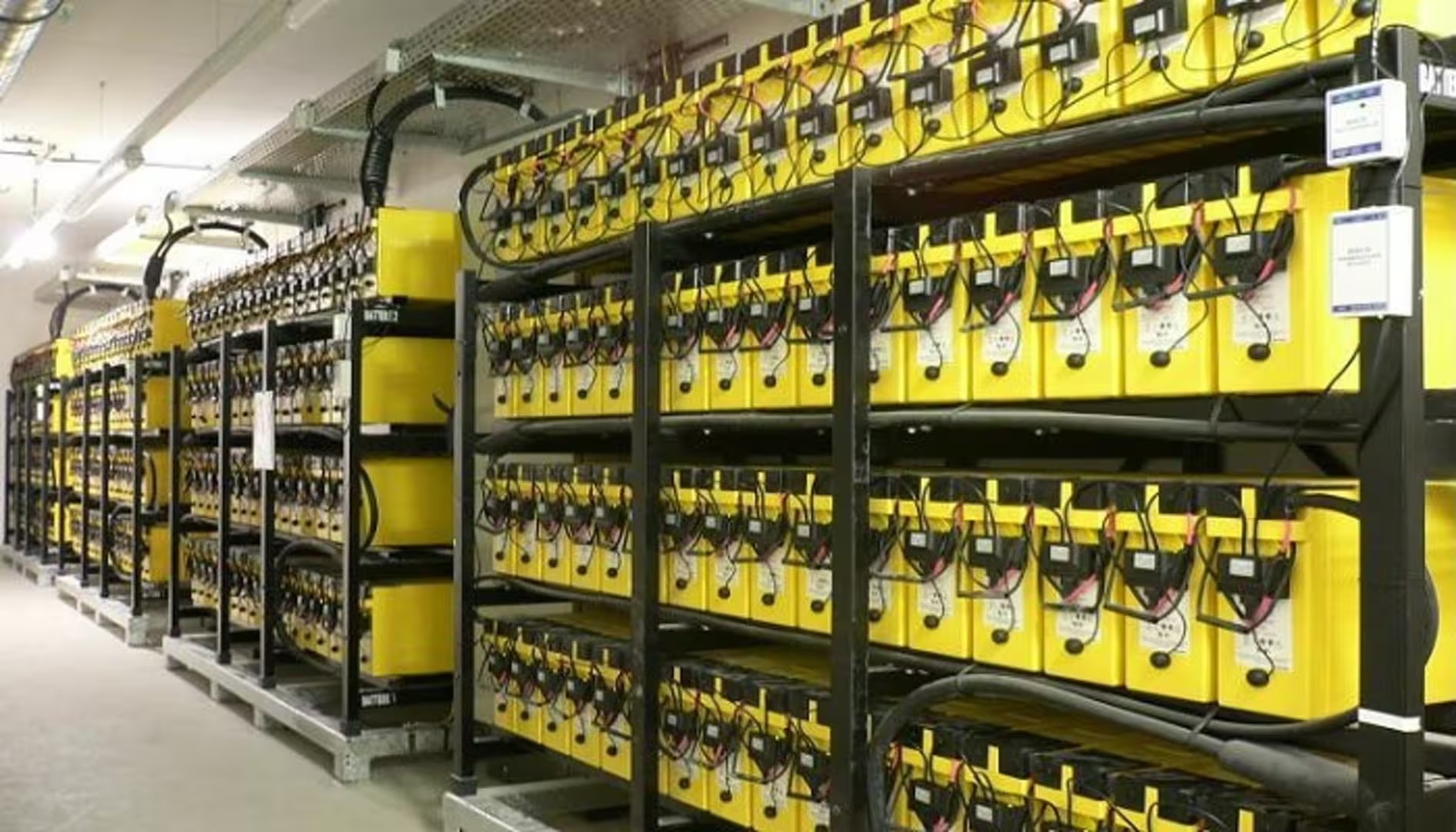
Data Center Battery Systems
Battery systems are a critical component of backup power infrastructure in data centers and other mission-critical facilities. They provide stored electrical energy to support critical loads when the normal utility power supply is interrupted or becomes unavailable.
In data center applications, battery banks are commonly integrated with Uninterruptible Power Supply (UPS) systems to provide immediate backup power during a utility failure and maintain critical loads while the standby power source, such as a diesel generator, starts and stabilizes.
Battery system capacity is selected according to the connected critical load, UPS characteristics, required backup runtime, system voltage, discharge performance, environmental conditions, redundancy requirements, and the technical specifications of the project.
Depending on the application and approved design, different battery technologies may be considered. Selection should take into account performance, expected service life, footprint, operating temperature, maintenance requirements, charging characteristics, safety requirements, and compatibility with the associated UPS system.
Battery banks may be installed in dedicated battery cabinets, racks, or battery rooms depending on system capacity and project requirements. Installation arrangements should provide appropriate access, clearances, ventilation, environmental conditions, electrical protection, and safe maintenance access.
Temperature is an important operating parameter for many battery technologies. Battery areas should therefore be coordinated with the mechanical and ventilation systems according to the battery manufacturer's requirements and the approved project design.
A Battery Monitoring System can be provided where required to monitor available parameters such as battery voltage, string voltage, current, temperature, internal resistance or conductance, alarms, and other battery health indicators supported by the selected system.
Battery monitoring provides maintenance teams with operational information that can assist in identifying abnormal conditions and planning inspection or maintenance activities before they affect the availability of the backup power system.
Proper electrical protection and isolation are also important parts of battery system design. Battery disconnect devices, protection equipment, DC cabling, terminations, polarity identification, and equipment ratings should be coordinated with the UPS and battery manufacturer's requirements.
The battery system should also be coordinated with the overall standby power architecture, including UPS systems, generators, Automatic Transfer Switches (ATS), electrical distribution systems, and the required backup power sequence.
Perfect Solution Contracting provides integrated data center battery solutions covering load and runtime assessment, equipment selection, supply, installation, battery interconnection, protection, monitoring, testing, and commissioning in accordance with project requirements.
- Battery banks for data center UPS and backup power applications.
- Battery capacity sizing based on critical load and required backup runtime.
- Coordination with Uninterruptible Power Supply (UPS) systems.
- Selection of battery technology according to project and equipment requirements.
- Battery cabinets, racks, or dedicated battery room arrangements as required.
- Coordination of operating temperature, ventilation, and environmental conditions.
- Battery Monitoring System integration where required.
- Monitoring of battery and string parameters supported by the selected system.
- DC protection, isolation, cabling, and termination coordination.
- Coordination with standby generators and Automatic Transfer Switches (ATS).
- Battery inspection and electrical testing during installation and commissioning.
- Functional testing with the associated UPS system.
- Integration with compatible monitoring or Building Management System (BMS) platforms where required.