
Water & Fuel Leak Detection Systems for Data Centers
Water and fuel leak detection systems provide early warning of liquid leaks within data centers and other critical facilities. Early detection can help facility teams respond to abnormal conditions before a leak develops into a more significant operational or equipment-related incident.
Data centers contain several potential sources of water, including chilled-water piping, precision cooling equipment, condensate drainage systems, mechanical services, and other water-bearing infrastructure. Monitoring these areas can provide early indication of leakage near sensitive electrical and IT equipment.
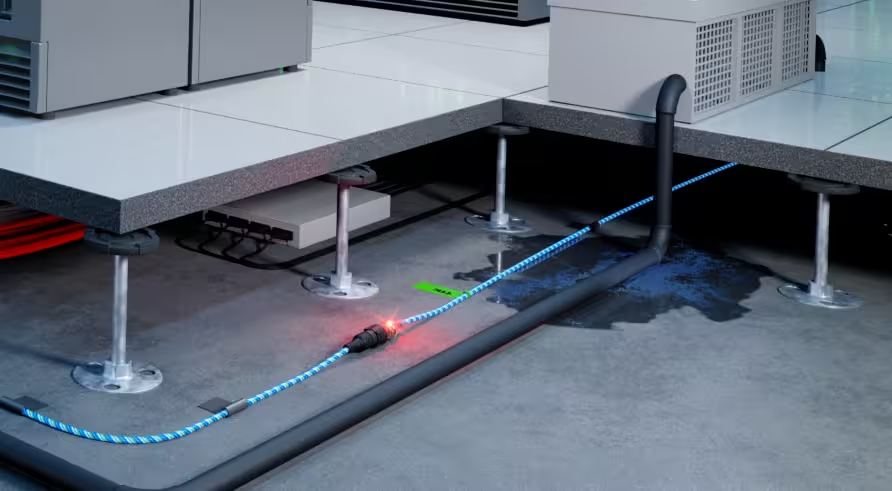
Water leak detection may use Leak Detection Cables, point sensors, probes, or other compatible sensing devices depending on the protected area and selected system.
Leak detection cables can be routed around critical equipment, along pipe routes, below cooling units, and within other areas where water leakage could create an operational risk.
Point leak sensors can be installed at specific locations such as drain pans, equipment bases, low points, valve locations, or other areas identified by the approved monitoring strategy.
In data centers with raised floors, water detection devices may be installed within the underfloor space where chilled-water piping, condensate drainage, cooling equipment, or other potential sources of leakage are present.
Fuel leak detection is particularly relevant around standby diesel generator infrastructure. Monitoring may be required around fuel storage tanks, day tanks, fuel transfer pumps, valves, piping, and other components of the generator fuel system.
Water and hydrocarbon fuels have different physical and electrical characteristics. The sensing technology should therefore be selected according to the liquid being monitored. A sensor intended for water detection should not automatically be assumed suitable for diesel fuel or other hydrocarbons unless specifically designed and approved for that application.
Sensors and sensing cables can be connected to a Leak Detection Controller that continuously supervises the monitored circuits and generates alarms when a leak condition or supported system fault is detected.
The system can be divided into multiple monitoring zones so that operators can identify the affected area and respond more efficiently. Zone arrangements should be coordinated with the physical layout and operational requirements of the facility.
Where supported by the selected equipment, Locating Leak Detection technology can provide an estimated leak position along a sensing cable. Exact location capability should only be specified when the selected system and installation arrangement support this function.
Leak alarms can be displayed locally and communicated to the Building Management System (BMS) or another compatible centralized monitoring platform. This allows facility operators to receive leak status, zone identification, alarms, and other supported information from a common interface.
Where required, leak detection alarms can also participate in an approved Cause & Effect sequence. Any automatic action, such as valve closure, pump shutdown, or equipment isolation, should be based on the approved control philosophy and coordinated with the associated mechanical and electrical systems.
Proper system design requires coordination with precision cooling equipment, chilled-water systems, drainage, raised floors, standby generators, fuel systems, electrical equipment, and other services that could either create or be affected by a liquid leak.
Testing and commissioning should verify sensor operation, sensing-cable continuity where applicable, zone identification, alarms, controller operation, communication interfaces, BMS integration, and any approved control sequences.
Perfect Solution Contracting provides integrated water and fuel leak detection solutions for data centers and critical facilities covering design coordination, sensor selection, leak detection cables, point sensors, controllers, cabling, monitoring integration, alarm configuration, testing, and commissioning in accordance with project requirements.
- Water leak detection for data centers, server rooms, and technical areas.
- Fuel leak detection for generator and fuel system areas.
- Leak Detection Cables for suitable water-monitoring applications.
- Point sensors and probes for designated leak monitoring locations.
- Underfloor leak detection where required.
- Monitoring around precision cooling and chilled-water infrastructure.
- Monitoring around fuel tanks, day tanks, pumps, valves, and fuel piping.
- Dedicated sensing technologies selected for water or hydrocarbon applications.
- Central Leak Detection Controller and alarm supervision.
- Multiple leak-detection zones according to facility requirements.
- Leak location identification where supported by the selected locating system.
- Local audible and visual alarm indication where required.
- Building Management System (BMS) integration where required and supported.
- Cause & Effect integration where specified by the approved control philosophy.
- Sensor, alarm, communication, and integration testing.
- Complete system testing and commissioning according to project requirements.