
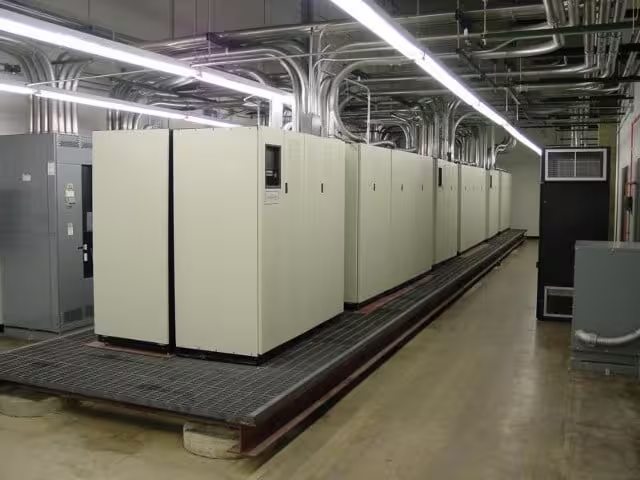
Uninterruptible Power Supply (UPS) Systems for Data Centers
Uninterruptible Power Supply (UPS) systems are a critical component of data center electrical infrastructure, providing immediate backup power to designated critical loads when the normal electrical supply is interrupted or falls outside the acceptable operating conditions of the selected system.
In a typical data center standby power architecture, the UPS supports critical IT and electrical loads immediately following a utility power failure. The associated battery system provides the required energy while standby generators start, stabilize, and become available to support the facility load.
UPS systems can support servers, storage systems, network equipment, telecommunications infrastructure, security systems, control systems, and other critical equipment according to the approved electrical design and load classification.
Proper UPS sizing should consider both kVA and kW requirements, connected load characteristics, power factor, future expansion, required redundancy, battery runtime, and the operating characteristics of the selected UPS equipment.
Battery runtime should be selected according to the facility's backup-power strategy. The required autonomy depends on factors such as critical load, generator starting and stabilization time, transfer sequence, operational requirements, and the approved system design.
Depending on project requirements, UPS systems may use different battery technologies and battery-bank arrangements. Battery selection should consider compatibility with the UPS, required runtime, discharge characteristics, operating environment, installation space, monitoring requirements, and lifecycle considerations.
For facilities requiring higher levels of electrical availability, UPS systems can be configured with redundancy such as N+1, 2N, or other architectures defined by the approved data center power design.
Modular UPS systems may also be considered where appropriate, allowing capacity or redundancy to be configured using multiple power modules according to the selected equipment and project requirements.
UPS bypass arrangements are an important consideration for system operation and maintenance. Depending on the selected system, this may include an automatic Static Bypass and a Maintenance Bypass arrangement to support approved operating and maintenance procedures.
Coordination between the UPS and standby generator is particularly important. UPS input characteristics, generator capacity, voltage and frequency response, load steps, battery charging, and other system parameters should be evaluated as part of the overall standby power design.
UPS systems should also be coordinated with transformers, switchgear, distribution boards, Automatic Transfer Switches (ATS), circuit breakers, cabling, earthing, and other components of the electrical distribution system.
Electrical protection and isolation should be designed according to the selected UPS configuration and the approved electrical studies. Input, output, battery, and bypass connections should be coordinated with the required protective devices and switching arrangements.
Modern UPS systems can provide monitoring of operating parameters such as input voltage, output voltage, frequency, load percentage, battery status, operating mode, bypass status, and active alarms, depending on the selected equipment.
Where supported, UPS operating information and alarms can be integrated with the Building Management System (BMS) or another compatible centralized monitoring platform, allowing facility teams to supervise the system from a common interface.
Testing and commissioning should verify UPS operating modes, input and output parameters, battery operation, bypass functions, alarms, monitoring, communication interfaces, and the interaction between the UPS and associated standby power systems.
Where required, functional testing can also verify the transition from normal utility supply to battery operation and subsequent coordination with the standby generator and transfer system according to the approved operating sequence.
Perfect Solution Contracting provides integrated UPS solutions for data centers and critical facilities covering load assessment, system sizing, equipment selection, battery configuration, redundancy, bypass arrangements, supply, installation, electrical connections, monitoring integration, testing, and commissioning in accordance with project requirements.
- Uninterruptible Power Supply (UPS) systems for data centers and critical facilities.
- Immediate battery-backed power for designated critical loads.
- UPS sizing based on kVA, kW, power factor, and load characteristics.
- Battery runtime selection according to the required backup-power strategy.
- Coordination of UPS battery banks and battery monitoring.
- Modular UPS configurations where appropriate.
- Redundancy configurations such as N+1 and 2N where specified.
- Static bypass and maintenance bypass arrangements according to system design.
- Standby generator compatibility and coordination.
- Automatic Transfer Switch (ATS) and electrical distribution coordination.
- Input, output, battery, and bypass protection coordination.
- UPS operating status, load, battery, bypass, and alarm monitoring.
- Building Management System (BMS) integration where required and supported.
- Battery operation and bypass functional testing.
- Generator and standby-power sequence verification where required.
- Integrated system testing and commissioning according to project requirements.