
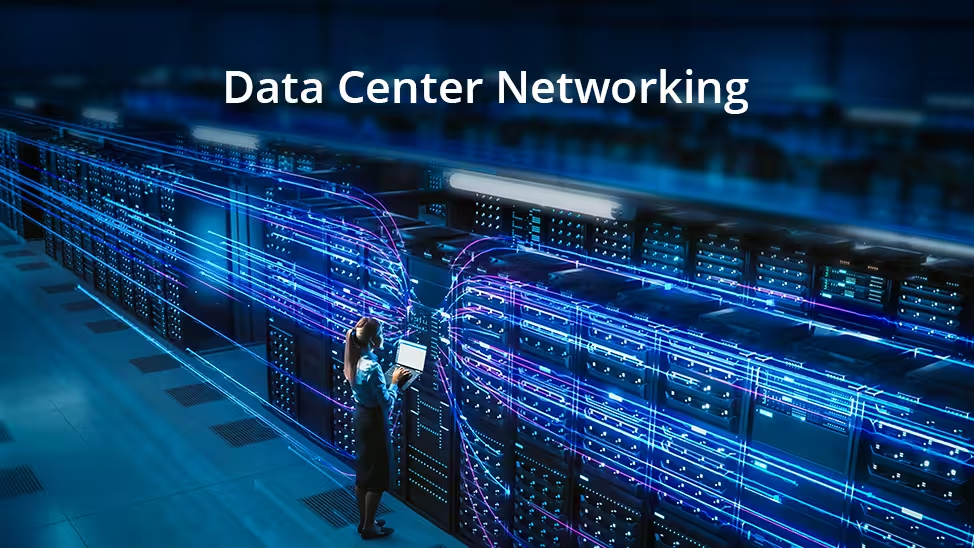
Data Center Networking & Connectivity
Networking and connectivity infrastructure forms a fundamental part of every data center, providing the physical communication pathways required to connect servers, storage systems, network equipment, security systems, management platforms, and external networks.
A properly designed Structured Cabling system provides an organized and scalable physical infrastructure for data transmission throughout the facility. The cabling architecture should be coordinated with the data center layout, equipment locations, rack arrangement, pathways, and future expansion requirements.
Fiber optic cabling Fiber Optic is commonly used for high-capacity backbone connections and other applications requiring high bandwidth or longer transmission distances. Fiber type, connector type, termination method, and pathway requirements are selected according to the approved network design.
Copper structured cabling can also be used for network, management, security, monitoring, and other data applications according to the required transmission performance and equipment interfaces.
Network racks and cabinets Network Racks provide organized mounting locations for switches, patch panels, fiber distribution equipment, cable management accessories, and other network components. Rack layouts should consider accessibility, equipment clearances, cable routing, power distribution, and airflow requirements.
Patch panels Patch Panels and fiber distribution systems provide structured termination and cross-connection points, allowing network connections to be organized, identified, maintained, and modified efficiently.
Proper cable management is essential within data center environments. Horizontal and vertical cable managers, trays, baskets, ladders, and other approved pathways can be used to maintain organized routing and support appropriate bend radius and cable protection.
Data and fiber cabling routes should also be coordinated with electrical power cables and other building services. Appropriate separation and routing practices help maintain an organized infrastructure and reduce the potential for interference or physical conflicts.
Where higher network availability is required, physically diverse or redundant cable pathways Redundant Paths can be incorporated into the infrastructure according to the approved network architecture and redundancy requirements.
Redundant pathways should be considered together with the overall network Redundancy strategy. Physical pathway redundancy alone does not guarantee network availability unless the active equipment, topology, power sources, and network configuration are designed accordingly.
Accurate identification and Labelling of racks, cabinets, patch panels, fiber panels, outlets, cables, and ports supports efficient operation, troubleshooting, maintenance, and future modifications.
Copper and fiber installations should be tested using appropriate test equipment and procedures. Testing can include copper certification and fiber continuity, loss, polarity, and other measurements required by the approved specifications.
Final documentation can include cable schedules, labeling records, test reports, rack elevations, termination information, and as-built documentation, providing facility teams with an accurate reference for operation and maintenance.
Perfect Solution Contracting provides integrated data center networking and connectivity solutions covering design coordination, structured cabling, fiber optic and copper cabling, racks and cabinets, patch panels, cable management, installation, termination, testing, labeling, documentation, and commissioning in accordance with project requirements.
- Data center Structured Cabling infrastructure.
- Fiber optic backbone and distribution cabling.
- Copper network cabling according to project requirements.
- Network racks, cabinets, and equipment organization.
- Copper and fiber Patch Panels.
- Horizontal and vertical cable management.
- Cable trays, ladders, baskets, and approved routing systems.
- Coordination and separation between data, power, and other services.
- Diverse and Redundant Paths where required.
- Rack, panel, cable, outlet, and port Labelling.
- Copper cabling certification and testing.
- Fiber optic testing according to project requirements.
- Cable schedules, test reports, and as-built documentation.
- Infrastructure planning to support future expansion requirements.