
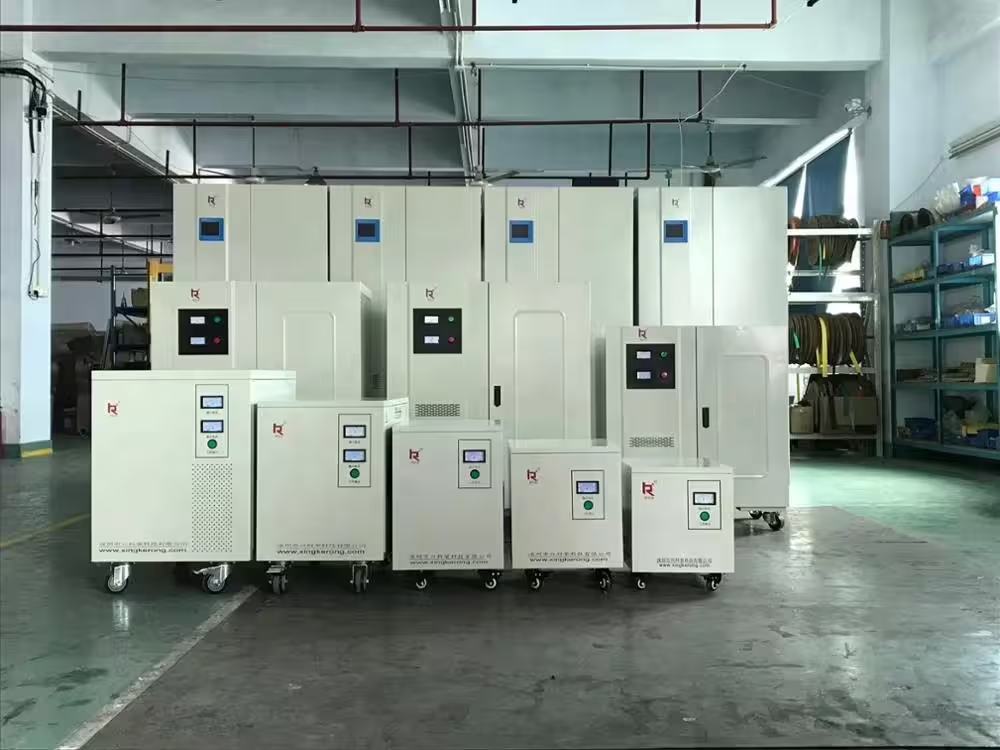
Voltage Stabilizers for Data Centers
Voltage stabilizers are used in electrical systems to regulate variations in incoming supply voltage and maintain the output voltage within the operating range required by connected equipment. In data centers and critical facilities, they may be applied where the characteristics of the incoming electrical supply require additional voltage regulation.
Sensitive electrical and electronic equipment can be affected by sustained undervoltage, overvoltage, or recurring voltage variations. A properly selected voltage stabilizer can compensate for specified input voltage variations and provide a more controlled output voltage within the equipment's designed operating range.
Automatic Voltage Regulation (AVR) allows the stabilizer to monitor incoming voltage and automatically adjust the output according to the operating characteristics of the selected equipment.
Stabilizer selection should be based on the actual electrical system characteristics, including connected load, required capacity, input voltage range, nominal output voltage, number of phases, load profile, allowable voltage tolerance, and future expansion requirements.
For three-phase applications, consideration should also be given to the characteristics of the supply and load, including voltage imbalance and the regulation method provided by the selected stabilizer.
Before specifying voltage regulation equipment, the electrical supply conditions should be evaluated to determine the nature of the power-quality issue. Measurements and Power Quality studies can help identify whether the primary concern is voltage variation, harmonics, transient overvoltage, frequency variation, or another electrical condition.
It is important to distinguish voltage stabilizers from other power-quality equipment. A voltage stabilizer is primarily intended to regulate voltage variations; it does not by itself correct every type of electrical disturbance.
Transient overvoltages and electrical surges are typically addressed using appropriately selected Surge Protection Devices (SPD), while harmonic distortion may require harmonic mitigation solutions such as Active Harmonic Filters according to the electrical study and project requirements.
Coordination with Uninterruptible Power Supply (UPS) systems is particularly important in data center applications. The stabilizer input and output characteristics should be compatible with the UPS and the overall electrical distribution architecture.
Voltage stabilizers should also be coordinated with transformers, standby generators, switchgear, distribution boards, circuit protection, cabling, and other components of the electrical system to achieve the intended operating sequence and protection philosophy.
Depending on the selected equipment, stabilizers may include bypass arrangements, protective functions, local displays, alarms, and monitoring of parameters such as input voltage, output voltage, load conditions, and operating status.
Where communication interfaces are available, operating status and alarms can be integrated with the Building Management System (BMS) or another compatible centralized monitoring platform according to project requirements.
Testing and commissioning should verify input and output voltage conditions, regulation performance, protection functions, bypass operation where provided, alarms, monitoring, communication interfaces, and integration with the associated electrical systems.
Perfect Solution Contracting provides voltage stabilization solutions for data centers and critical facilities covering electrical assessment, equipment selection, system sizing, supply, installation, electrical connections, protection coordination, monitoring integration, testing, and commissioning in accordance with project requirements.
- Voltage stabilization for data centers and critical electrical installations.
- Automatic Voltage Regulation (AVR).
- Compensation for specified undervoltage and overvoltage conditions.
- Single-phase and three-phase solutions according to project requirements.
- Capacity selection based on connected load and future requirements.
- Input and output voltage range assessment.
- Power-quality assessment where required.
- Coordination with Uninterruptible Power Supply (UPS) systems.
- Coordination with standby generators and transformers.
- Coordination with switchgear, distribution, and electrical protection systems.
- Bypass arrangements where provided by the selected equipment.
- Input, output, load, status, and alarm monitoring where supported.
- Building Management System (BMS) integration where required and supported.
- Electrical protection and operational testing.
- System testing and commissioning according to project requirements.